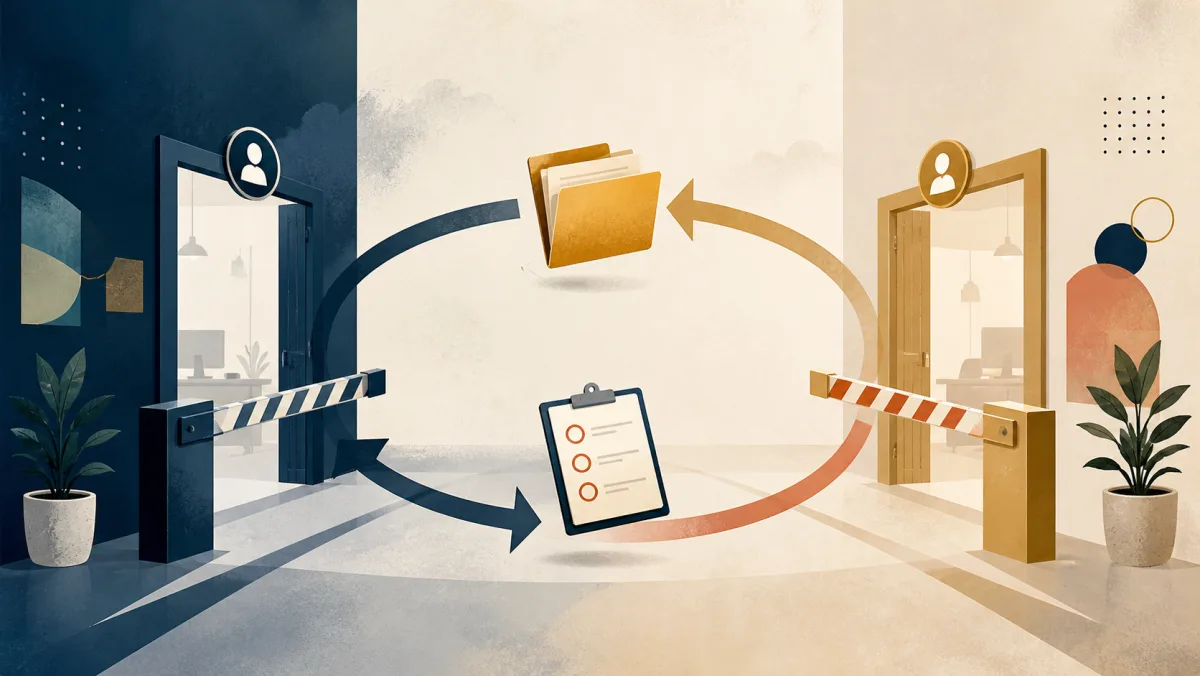
A Catch-22 is a trap created by rules or conditions. You need A to get B, but you need B before you can get A.
“We’re in a Catch-22: security needs production data to approve the test, but we can’t access production data until security approves it.”
The phrase usually criticizes the process, not a person's effort.
Quick check
How well do you know "Catch 22"?
You know "Catch 22" well.
Keep going with the full learning path — more workplace contexts, related expressions, and practice using it yourself with feedback.
Continue with "Catch 22" →There's more to "Catch 22" than it seems.
You've got part of it, but the full learning path goes deeper into its nuances, workplace contexts, and when it sounds natural — then gives you practice using it yourself.
Learn "Catch 22" in depth →Where does Catch-22 come from?
The expression comes from Joseph Heller's 1961 novel Catch-22. In the novel, a fictional military rule traps airmen through circular logic. The book is more complex than today's workplace shorthand. Its title became a common noun for this kind of trap.
Modern dictionaries also include a broader sense in which two illogical or dependent conditions block each other.
Capitalization varies, but the hyphen is standard. Catch-22 is the book title, while lowercase catch-22 is common for the general noun. Many people know the expression without reading the novel.
What makes something a real Catch-22?
The key pattern is a circular dependency:
- You need approval to gain access.
- The approver requires evidence that can be produced only with access.
- No ordinary path satisfies both requirements.
A hard choice is not always a catch-22; two costly options may create a trade-off or dilemma. A difficult task may be an obstacle, so use catch-22 when rules or conditions create a loop.
Try it yourself
Use "Catch 22" yourself
What might you hear at work?
“Candidates need experience, but they can’t get experience without being hired. It’s a Catch-22.”
The speaker describes an entry barrier with circular requirements.
“We need a local bank account to set up payroll, and the bank wants proof of payroll. That feels like a Catch-22.”
Feels like leaves room for an unknown path through the process.
“This isn’t a Catch-22; we can use the sandbox data for approval.”
Someone has identified a third path that breaks the loop.
“The project is caught in a Catch-22.”
This is understandable. However, we’re in a catch-22 or the process creates a catch-22 often sounds more natural.
What can you say naturally?
To name the loop:
“We may have a Catch-22: each approval depends on the other.”
To ask for precision:
“Which two requirements make the situation circular?”
To move toward a solution:
“Could either owner grant a limited exception so we can produce the evidence?”
To respond when you do not know the reference:
“Do you mean the requirements block each other?”
The last question gives the meaning without requiring literary knowledge.
Recognition before production
When you hear catch-22, look for conditions that block each other. A speaker may also use the phrase loosely for a frustrating limit. Ask about the loop before correcting them.
When you use it, state the actual dependencies next. “It’s a catch-22” shows frustration. “Access requires approval, while approval requires access evidence” shows what colleagues can change.
Many U.S. workers know the phrase, but familiarity still varies. In a global policy, circular dependency or a direct explanation may be clearer.
Tone, hierarchy, and policy
Calling a process a catch-22 may criticize its owners or designers. Hedge when some facts are missing:
“I may be missing an approved path, but these two requirements appear circular.”
This invites correction before you call the policy irrational.
In high-stakes work, an apparent conflict may have an exception or escalation path. Do not bypass controls because the process feels absurd. Record the requirements and ask the authorized owner.
Do not use the phrase to make someone's identity or circumstances a joke. Focus on the rules and conditions.
For another literary reference about surveillance and control, see Big Brother is watching at work. For a metaphor about one hidden weakness, see Achilles’ heel.
The practical takeaway
A catch-22 is a circular trap, not merely a hard choice. Name the requirements that block each other. Then ask which rule an authorized owner can clarify, reorder, or waive.
Sources
- Library of Congress catalog: Catch-22 by Joseph Heller
- Merriam-Webster: “catch-22”
- Encyclopaedia Britannica: Joseph Heller and Catch-22
A lot to take in? It is.
But Rome wasn't built in a day. Build your American workplace English one expression and cultural reference at a time—with curated explanations and structured practice in Lyra Practice.
Start a session →