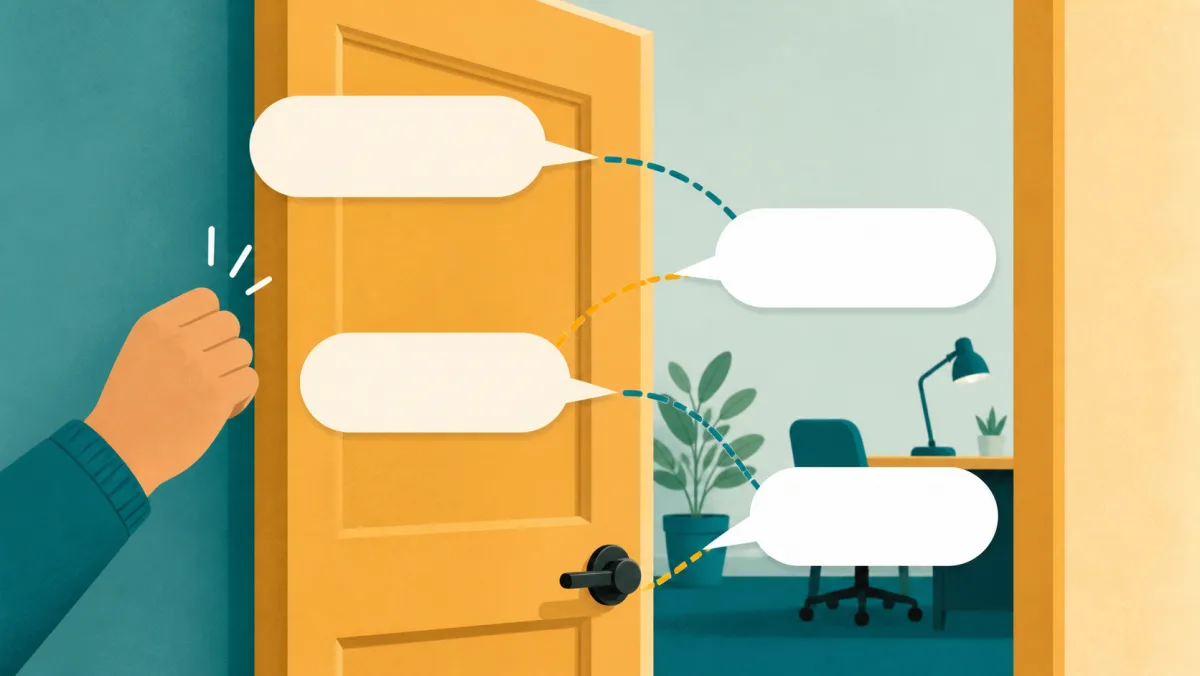
“Knock, knock.”
If you know English-language shows and books, you may answer, “Who’s there?” without thinking. If the form is new to you, the exchange may seem odd: why is someone acting as if they are at a door, and how does everyone know the next line?
A knock-knock joke is a short, structured dialogue. Oxford Learner’s Dictionaries says this form often uses one expression that sounds like another, and the listener follows the pattern so the speaker can complete the wordplay.
The five-part pattern
The basic structure is:
- Speaker: “Knock, knock.”
- Listener: “Who’s there?”
- Speaker: a name, word, or short sound.
- Listener: repeats it and adds “who?”
- Speaker: delivers a line that changes how the repeated sound is understood.
The pretend door gives the listener a reason to ask who is there, but the “visitor” is often just a sound for the last line. A sound that seems like a name may become the start of a sentence, or one spoken word may split into two words.
The listener has an active role: saying “Who’s there?” and then “[word] who?” gives the speaker the required prompt. The joke works like a brief, cooperative word game.
Why it can be funny
The listener knows that the meaning will change, but not how. First, the listener hears the sound as a name or word; then the last line gives it a second meaning.
The form is often associated with children and intentionally corny humor. Adults may use it for nostalgia, deliberate silliness, or a quiet moment. Like a dad joke, it may get a playful groan because people recognize the simple wordplay.
The opening provides a clear tone clue. Sarcasm can sound like a serious statement, but “Knock, knock” usually announces that a joke is starting. A smile, exaggerated pause, or playful voice can make this even clearer.
A lot to take in? It is.
But Rome wasn't built in a day. Build your American workplace English one expression and cultural reference at a time—with curated explanations and structured practice in Lyra Practice.
Start a session →Why non-native speakers may miss the payoff
Pronunciation is often harder than the vocabulary itself. The last line may depend on:
- two words that sound alike;
- a name that resembles part of a sentence;
- a different boundary between spoken words;
- reduced pronunciation in fast speech;
- an accent-specific similarity.
You may understand every word and still miss the connection, while written spelling can make it even less clear. These problems also occur in English puns more generally.
The sounds may match in one accent but not in another. English speech differs across the United States and the world, so even native speakers may not catch every pun at once.
What you might hear at work
You are more likely to hear this joke during an icebreaker, a casual video call, or a team chat than in a formal talk. A coworker might write “Knock knock…” before a silly pun because they want someone to type “Who’s there?”
You can participate with the expected response:
“Who’s there?”
After the next word, repeat it and add “who?” If the speaker says “Update,” you answer, “Update who?” The last line should show the sound link. Following the pattern lets the speaker complete the joke.
If you do not want to perform, you can still respond warmly:
- “I know the format—go ahead.”
- “I may need help with the wordplay.”
- “I heard the sound, but I missed the second meaning.”
- “That one works better aloud than in writing.”
Recognition before production
For a learner, recognizing the pattern may be more useful than creating a joke. Once you answer “Who’s there?”, you show cultural understanding without having to produce a clever line.
If you make one, start with the final sentence and listen to its first sounds. Could they sound like a name or a visitor at the door? Keep the last line short, then test it aloud with someone who uses a similar accent.
Do not copy an ethnic or local accent just to force the sounds to match. Avoid jokes about a coworker’s name, speech, identity, or English errors. An agenda, calendar, file, or software update is often a safer topic.
When the format may not fit
The joke may feel childish or distracting in a serious meeting, during hard feedback, or during an urgent event. A senior leader should not demand that staff join in because some people may not feel free to say no.
U.S. workplaces do not share one humor style. Some teams enjoy scripted jokes, while others rarely use them. International coworkers may know the format from television, but others may never have met it. A person who does not answer “Who’s there?” may not recognize the pattern, so their silence does not prove that they are unfriendly.
The practical takeaway
A knock-knock joke is a set five-part exchange. It builds toward English wordplay based on sound. You can answer “Who’s there?”, listen for a second meaning, and ask if you miss it. At work, save the form for relaxed settings. Focus the joke on neutral things, not people.