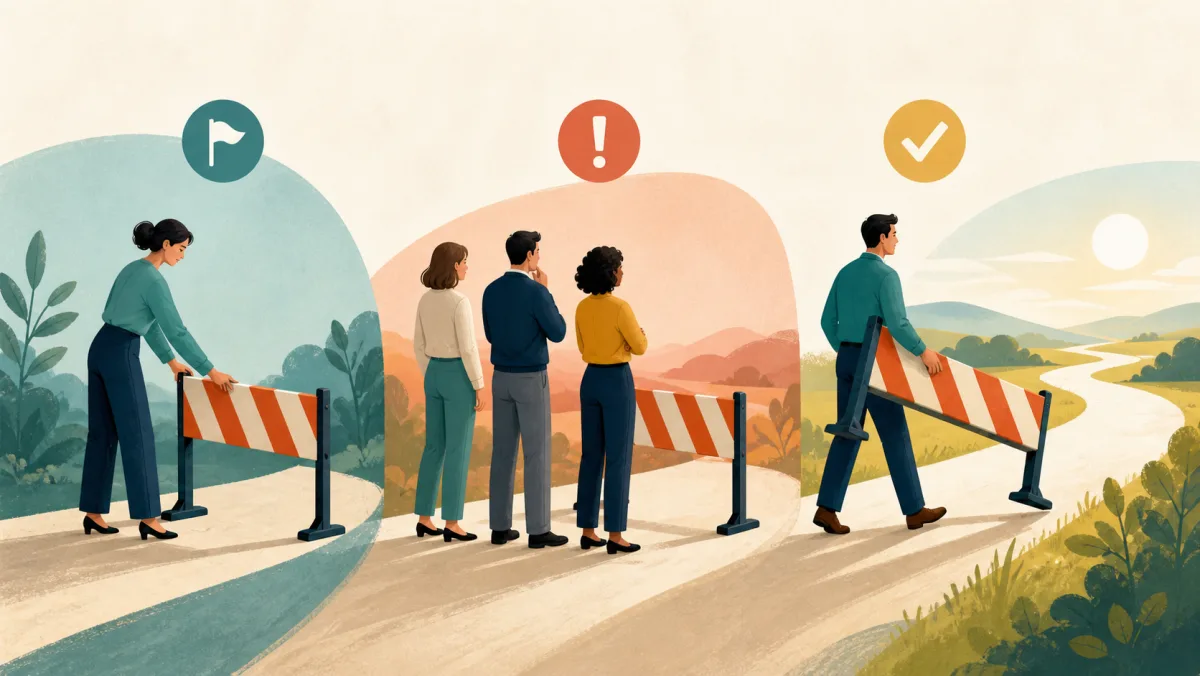
Blocker often appears with a small set of verbs. Learning these "standard collocations" will make your professional English sound more natural.
Common pairs include "raise/flag/report," "hit/run into," and "clear/remove/resolve/address/escalate." The usual adjective is "blocking," as in a blocking issue or bug. In software teams, you may also hear the noun used before another noun, as in "blocker bug."
Quick check
Escalated or cleared?
You know "Blocker" well.
Keep going with the full learning path — more workplace contexts, related expressions, and practice using it yourself with feedback.
Continue with "Blocker" →There's more to "Blocker" than it seems.
You've got part of it, but the full learning path goes deeper into its nuances, workplace contexts, and when it sounds natural — then gives you practice using it yourself.
Learn "Blocker" in depth →The three-stage lifecycle
You can group these verbs by the stage of the problem, which makes them easier to learn. A useful shortcut is to think of "surfacing," "encountering," and "responding."
Surfacing it:
"I want to flag a blocker before we lose more time on this."
Encountering it:
"We hit a blocker in testing when the staging environment went down."
Resolving it:
"This blocker was cleared as soon as IT reset the permissions."
"Raise," "flag," and "report" all bring a blocker to someone's attention, though their tone can vary by team. "Flag" is common in Slack or a standup, while "report" can sound more formal. "Hit" and "run into" describe encountering the problem, but "run into" is a little more conversational. "Clear," "remove," and "resolve" suggest that the barrier is gone. "Address" may mean working on it, even if it remains. "Escalate" means taking it to someone with more authority or resources; it does not mean the blocker is fixed.
Try it yourself
Use the verb for encountering a barrier
What doesn't work: "make" or "do" a blocker
"Make a blocker" and "do a blocker" are not standard pairs in this sense. A blocker is usually something you find, name, work on, or clear. If a person creates one, say they "caused a blocker" or "introduced a blocker."
The adjectival trap: "blocking" vs. "a blocker bug"
A related pattern uses "blocking" as an adjective. It can describe an issue, bug, dependency, or question. This form is common in code review and bug triage.
"This is a blocking bug -- we can't ship until it's fixed."
"A blocking bug" is clear across teams, while the noun can stand on its own: "this bug is a blocker." "Blocker bug" is also established software jargon, but it may be less clear outside technical teams.
The mistake to avoid
Avoid weak verb pairs such as "make a blocker" or "do a blocker." Also learn the broadest noun and adjective patterns: "a blocker" and "a blocking bug." In a software team that uses "blocker bug," that form is natural too.
Learning the set as a group
Learn these pairs as a group. They cover many common stages of a blocker. Start with "flag," "hit," and "clear," then add close options. Keep "blocking" in mind for the usual adjective form. This is a useful base, though teams may use other verbs too.
Practice scenarios
Practice using blocker in situations like:
- choosing the right lifecycle verb -- flag, hit, or clear -- for the stage a blocker is at
- avoiding unnatural pairings like "make a blocker" or "do a blocker"
- using "blocking" in general English and recognizing "blocker bug" as software jargon
Useful practice phrases:
- "I want to flag a blocker before we lose more time on this."
- "We hit a blocker in testing when [specific cause]."
- "This is a blocking dependency, so we cannot finish the release yet."
Want to actually use "Blocker" naturally at work?
Understanding it is one thing. Practice its nuances, see how it works in real workplace situations, and use it yourself with feedback.
Start the "Blocker" learning path →The main verb set follows a simple path: surface it, hit it, and clear it.
Keep the common noun and adjective patterns apart. Also remember that escalation reports a need; it does not prove a fix.