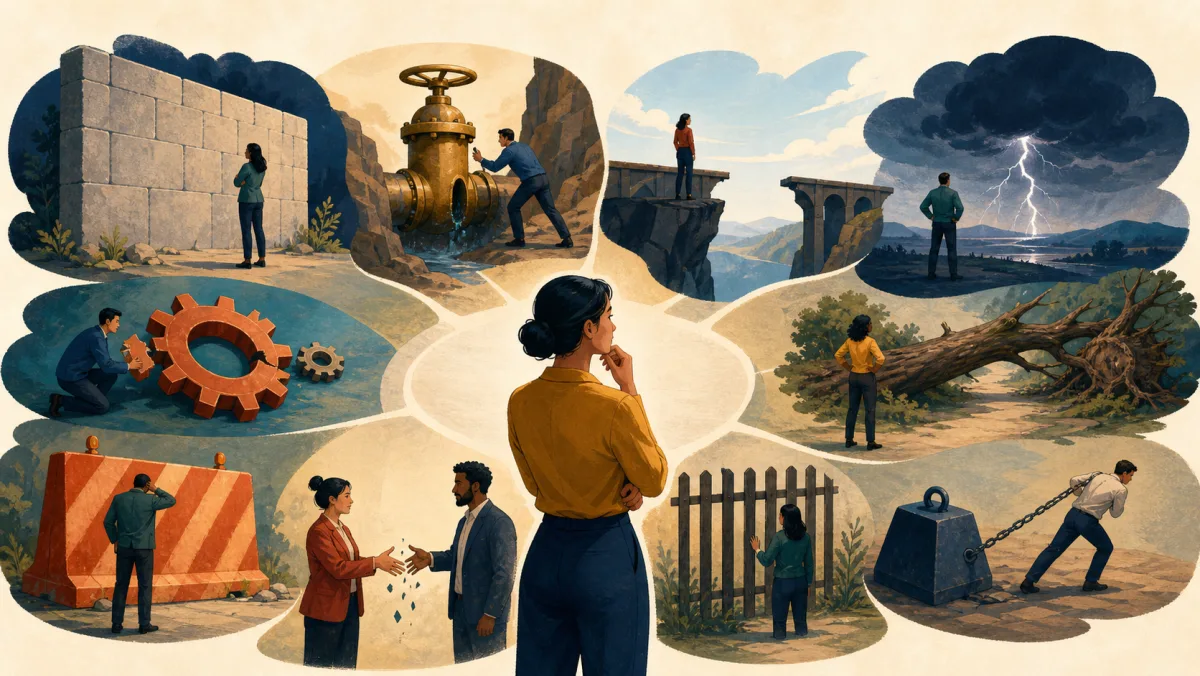
Blocker, bottleneck, dependency, risk, issue, roadblock, showstopper, deal-breaker, constraint, and impediment can all limit work. Mixing them up can lead teams toward the wrong response.
Choose the label that matches the evidence. A full stop points to blocker. A repeated slowdown points to bottleneck. A normal prerequisite points to dependency. Something that has not happened yet points to risk. A general problem points to issue. A broad obstacle points to roadblock. A threat to the whole deliverable points to showstopper. A condition that ends an agreement points to deal-breaker. A fixed limit that is not stopping work now points to constraint. An impediment is anything that hinders progress, especially in Agile work.
Why the label matters
Each word points to different evidence. A mix-up can lead to the wrong response. You might treat a normal dependency as urgent. Or you might treat a standing constraint as an emergency. Match the label to events, not only to how serious they feel.
Try it yourself
Turn a diagnosis into a useful status line
Test yourself: three scenarios
Scenario 1: "The internal password-reset tool is completely broken, so no employee can regain access to a locked account right now."
What is the diagnosis? This is a blocker, not a bottleneck. Work stops for anyone who is locked out. There is no partial flow to speed up.
Scenario 2: "A possible future price increase from a supplier, versus the fixed annual travel budget the team has planned around all year."
What is the diagnosis? The possible price increase is a risk. The fixed travel budget is a constraint. Neither is a blocker unless it stops a purchase today. The risk has not happened yet. The team already planned around the known limit.
Scenario 3: "One manager who can approve only a handful of discount requests a day, a completely broken checkout page affecting one ticket, and a payment-processor outage on launch day that would take down the whole release."
What is the diagnosis? The manager's limited capacity is a bottleneck. Requests still move, but slowly. The broken checkout page blocks that one ticket. The ticket cannot move until the page is fixed. Yet the rest of the release can continue. The payment outage on launch day is a showstopper. It would stop the whole release, not just one part.
Common mistakes
A common mistake is choosing a label based on urgency alone. The correct label does not depend only on feelings. An urgent situation can still be a dependency or risk. A routine situation can still be a real blocker. Check the evidence before you choose the word.
Making the check automatic
You do not need to memorize ten separate definitions. Instead, run the same short check each time. Has anything stopped now? Or is work capped, delayed, or planned around? Has the event happened, or is it still possible? Does it affect the whole deliverable or one part? These three questions usually point you toward the right word.
Practice scenarios
Practice blocker in these situations:
- diagnosing the right label from workplace evidence across all nine near-word contrasts
- avoiding picking a label based on how urgent a situation feels rather than what's actually happening
- distinguishing a task-level blocker from a whole-release showstopper
Useful practice phrases to try:
- "That's a blocker, not a bottleneck -- nothing is moving at all."
- "That's a risk, not a blocker -- it hasn't happened yet."
- "That's a showstopper, not a blocker -- it would take down the whole release, not just one part."
Want to actually use "Blocker" naturally at work?
Understanding it is one thing. Practice its nuances, see how it works in real workplace situations, and use it yourself with feedback.
Start the "Blocker" learning path →Ten words point to ten different kinds of evidence.
Check what happened before you choose one of them.