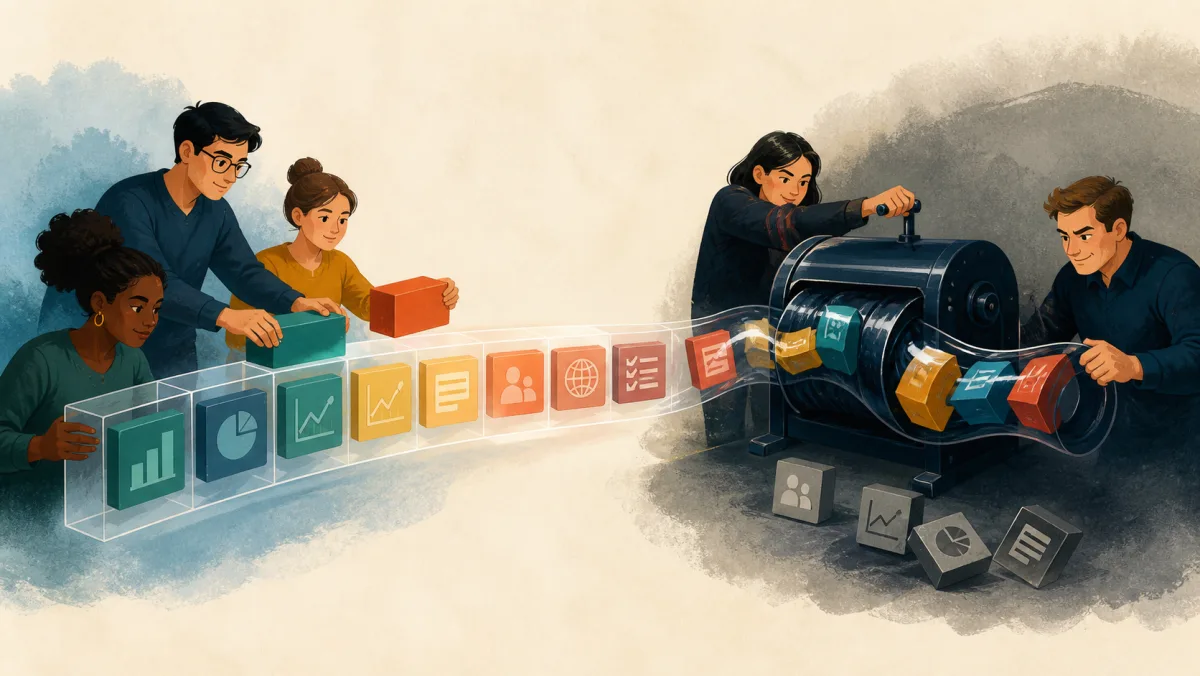
"Narrative" and "spin" can both concern how people present events, but they take different stances toward that framing. A narrative is an account that links facts and meaning, while spin is a critical term for framing that seems slanted or too favorable.
Quick check
How well do you know "Narrative"?
You know "Narrative" well.
Keep going with the full learning path — more workplace contexts, related expressions, and practice using it yourself with feedback.
Continue with "Narrative" →There's more to "Narrative" than it seems.
You've got part of it, but the full learning path goes deeper into its nuances, workplace contexts, and when it sounds natural — then gives you practice using it yourself.
Learn "Narrative" in depth →Spin is inherently more accusatory
A "narrative" can be accurate, incomplete, disputed, or false; the word itself does not prove quality. "Spin" suggests selective or slanted framing and often raises doubt about fairness, but it does not by itself prove an intent to deceive.
"Our narrative links the layoffs to the plan announced in Q1." This states the team's account, but evidence is still needed to support the link.
"I think that is spin because the summary omits two weak quarters." This criticizes the selection of facts without claiming to know the writer's intent.
Calling something "spin" is not a neutral edit. It can sound like a charge of bias or deception. Use it with care. Point to the missing fact, weak comparison, or slanted wording. That gives others a claim they can check.
Try it yourself
Use "Narrative" yourself
Why the two words are asymmetric
Teams often describe their own work as building a narrative. That means they are joining facts into a clear account. They rarely call their own work "spin" unless they are joking or admitting bias. When used about someone else, "spin" is usually critical. The force still depends on tone and context.
Avoid: "Let's spin this for the board." Clearer: "Let's explain the result to the board and include the relevant unfavorable numbers too."
The clearer version sets a testable standard and calls for relevant data, not just favorable data. Still, accurate data can be framed in more than one fair way, so explain the method and note key limits.
Where the mistake actually causes damage
Calling your own work "spin" can weaken trust, even as a joke. Readers may hear an admission: "We plan to shade the facts." Use a more exact verb, such as explain, frame, summarize, or argue, and then show supporting evidence.
Calling a colleague's narrative "spin" can also raise conflict. It may sound like a charge about their fairness or honesty. If the issue is a missing fact or a weak choice of baseline, name that issue. Do not claim bad intent unless you have sound evidence and a reason to make that claim.
Practice scenarios
Practice distinguishing narrative from spin in situations such as:
- describing your team's account without claiming it is proven
- pointing out selective framing with clear evidence
- replacing the vague charge "spin" with a testable concern
Useful practice phrases:
- "Our narrative connects [the facts] to [the plan]; the evidence is..."
- "This seems selective because it leaves out [relevant fact]."
- "Let's frame this clearly and show the method and limits."
Want to actually use "Narrative" naturally at work?
Understanding it is one thing. Practice its nuances, see how it works in real workplace situations, and use it yourself with feedback.
Start the "Narrative" learning path →Narrative names an account. Spin is a critical label for slanted framing. Neither word settles what is true or proves why a person chose that frame.