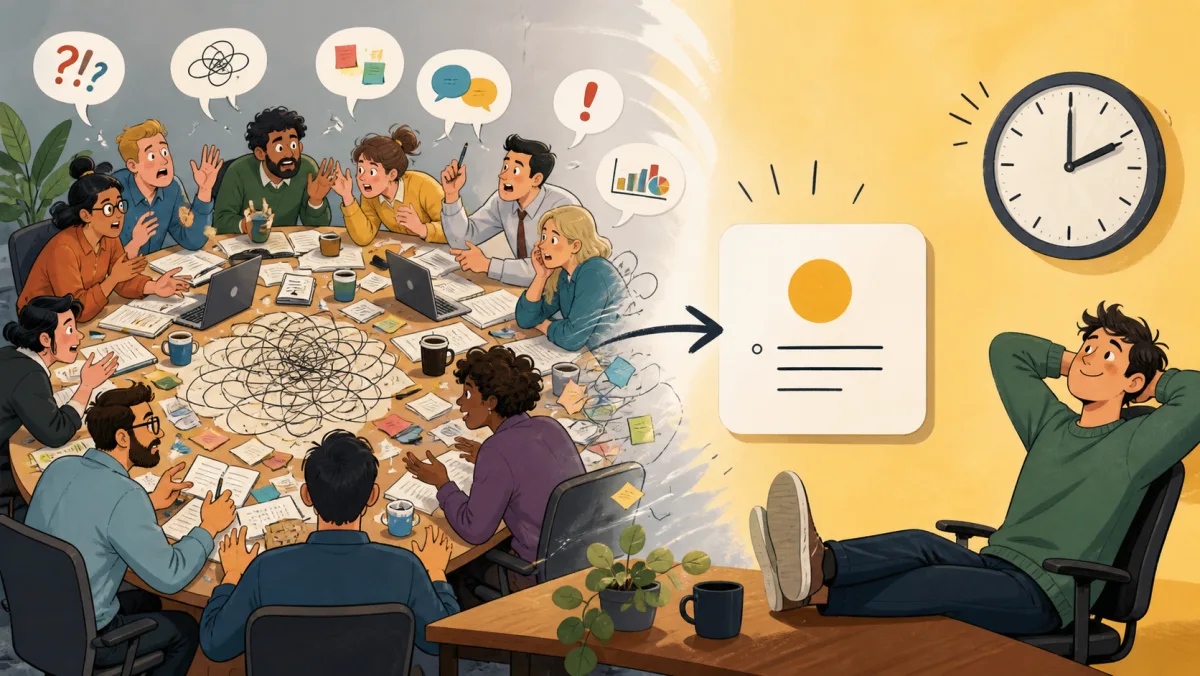
“This meeting could have been an email” means a speaker thinks the meeting was not worth its cost. They believe a written update could have done the job.
“We joined a 45-minute call just to hear one date. That meeting could have been an email.”
The sentence is literal, but it often works as a joke or complaint. It mocks a complex process used to share a simple update.
What do the words literally claim?
Could have been points to another choice in the past. The meeting happened, but the email did not replace it. The speaker now thinks writing would have been enough.
The shared script contrasts two communication channels:
- a meeting requires shared time, attendance, and live attention;
- an email can deliver a stable update that recipients read at different times.
The joke assumes that live discussion did not add enough value. Debate, a sensitive talk, or a group decision might have justified the meeting.
That assumption may be fair, but it is still an interpretation. A meeting organizer may have expected discussion even if none occurred.
Why does it function as a joke?
Part of the humor comes from a fall from high importance to a plain email. Invitations, agendas, links, and many guests suggest a major event. The result may be one short update.
It also packs criticism into one familiar line. The speaker does not explain exactly what went wrong.
The joke reflects a real concern for some workers. In Microsoft's 2023 survey, respondents ranked inefficient meetings as a leading barrier to productivity. Microsoft also used the email question when discussing the results. A company survey cannot prove that one meeting was unnecessary.
A lot to take in? It is.
But Rome wasn't built in a day. Build your American workplace English one expression and cultural reference at a time—with curated explanations and structured practice in Lyra Practice.
Start a session →What might you hear at work?
After a call, a peer might say privately:
“Well, that could have been an email.”
Could have looks back and questions the format. A stronger version is:
“This should have been an email.”
Should have says the organizer chose the wrong format. Could have presents email as a workable choice, though the tone can still sound harsh.
The line also appears on mugs, memes, and virtual backgrounds. There, it may show general meeting fatigue rather than target one person.
What can you safely say in response?
If a peer says it after a low-value meeting:
“The main update was the revised date, right?”
“Agreed that the status portion could be async. The decision section may still need discussion.”
“I’ll suggest a written update next time.”
These replies address the useful point without attacking the organizer.
If you organized the meeting, ask for actionable feedback:
“Which part would you move to email, and what would still benefit from live discussion?”
That question turns the joke into useful feedback.
How can you express the idea professionally?
Before a meeting:
“Could we handle this as an asynchronous update?”
“What decision requires live discussion?”
“If this is informational only, I can send a concise written summary.”
After a meeting:
“For future status updates, a written format may save the team time.”
“The discussion became useful once we reached the trade-off. Could we circulate the background in advance?”
These options focus on the format, not the organizer's skill.
When is producing the joke risky?
Posting it while the organizer speaks may look rude. The joke can also embarrass a new employee after a first presentation. Ask about the goal and format instead.
Live talk may help with conflict, privacy, access needs, emotion, or a fast group choice. Email is not always cheaper. A long thread can take more time than a focused call.
Hierarchy also affects the risk. A leader may seem to blame people who had to attend. A junior employee may appear openly rude about an executive's session. The result depends on the team and relationship.
How do you avoid the literal-listener trap?
A learner may wonder whether the speaker still wants an email. Often, the phrase only judges the past meeting. It is not always a request to send the content again. You can check:
“Would a written recap still be helpful, or are you commenting on the format?”
For language that improves the next meeting, see how to close a meeting with clear next steps. To preserve decisions asynchronously, see documenting decisions after meetings.