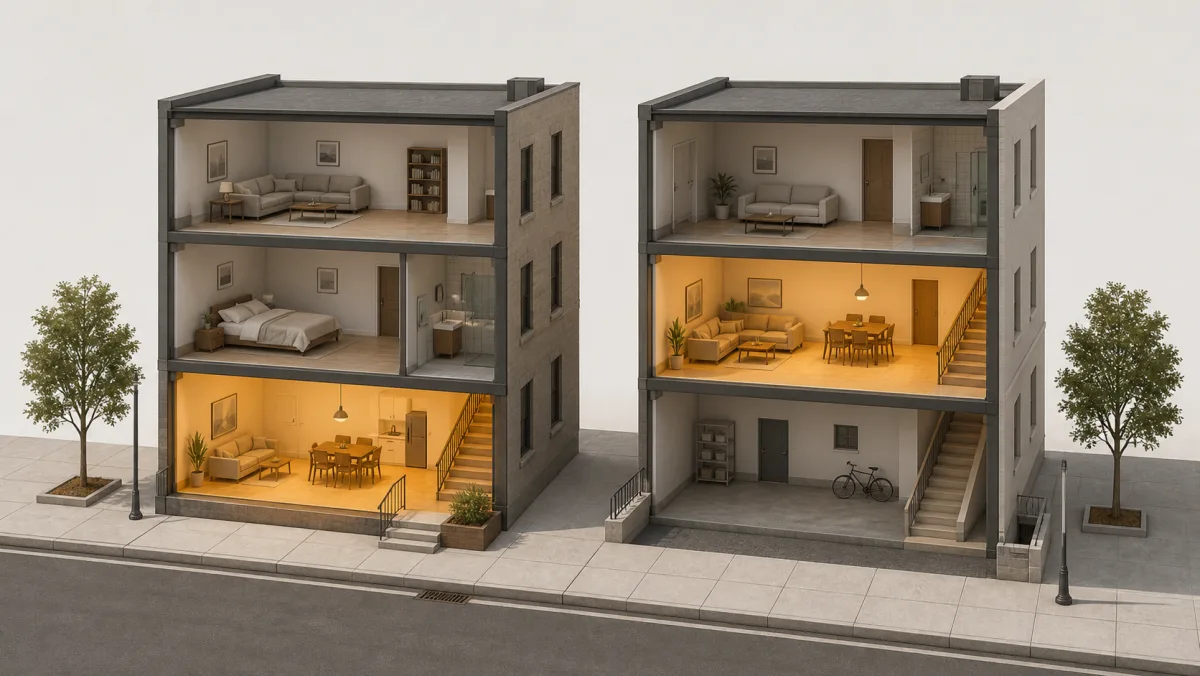
In most US buildings, the first floor is at the main ground-level entrance. The second floor is one level above it.
This system is not used in every country. In British English and some other forms of English, the entrance level is the ground floor, and the first floor is one level above it. So, “Meet me on the first floor” may send two people to different levels.
“You will find reception on the first floor.”
In a typical US office, this likely means the street level. Still, check the building signs.
The usual American pattern
A basic US building often uses these labels:
- basement: a level under the ground
- first floor: the main entrance or street level
- second floor: the next level above the first
- third floor: the level two floors above the first
US speakers also use ground floor for the level at the ground. In many buildings, ground floor and first floor mean the same level. Yet labels can vary by building.
Oxford’s learner dictionary gives the same North American pattern. It also notes that a public building may call street level the ground floor.
Why the label may still vary
A hotel, hospital, campus, or office may use G, L for lobby, M for main, or 1. A building on a hill may have outside doors on several levels. A parking garage may use P1, B1, or LL for lower level.
Some buildings skip a number, such as 13, and levels in joined towers may not line up. An old level name may also remain after a change to the building.
The US pattern is a useful starting point. It does not replace the signs, map, or elevator buttons in that building.
A lot to take in? It is.
But Rome wasn't built in a day. Build your American workplace English one expression and cultural reference at a time—with curated explanations and structured practice in Lyra Practice.
Start a session →What might you hear at work or while traveling?
“A security officer will meet you in the lobby on the first floor.”
In the US, this likely means the main entrance level. Follow any visitor guide or sign that says otherwise.
“Our group has moved upstairs to the fifth floor.”
This means the level marked five. It may not be four equal flights above every outside door.
“Take the elevator and press 2.”
The speaker means the button marked 2. In a typical US building, it is one level above the first floor.
“The conference room is at ground level, just beyond the front desk.”
Here, ground floor likely means street level. The words just beyond the front desk make the place easier to find.
“We serve breakfast on the same level as the lobby.”
Hotels may use lobby level to guide international guests. This wording avoids an assumption about floor numbers.
What can you say naturally?
For directions to a US visitor, say:
“Please check in at the first-floor desk inside the main entrance.”
For directions to an international group, say:
“Our meeting is on Level 2, so press the elevator button marked 2.”
If the label is unclear, ask:
“Does first floor mean the street level here, or the level above it?”
“Is that on the same level as the lobby?”
“Which elevator button should I press?”
These are reasonable questions, not evidence of weak English. Floor-numbering systems genuinely differ.
“Floor” and “story” are different kinds of description
In US English, floor can name a level people use: “Our office is on the sixth floor.” Story can describe building height: “It is a six-story building.” US English usually spells this word story. British English often uses storey for this meaning.
A split-level home or a building on a hill can make the count less clear. For a delivery or an emergency, give the official level and unit. Use the labels on the building.
Make workplace directions resilient
Give an important visitor more than one clear clue:
“Use the Pine Street door, visit security at ground level, and then take the elevator to 4.”
For an invitation to a hybrid meeting, write:
“Meet in Room 420 on the fourth floor of North Tower. Take the elevators next to the main lobby.”
This is clearer than “upstairs” or “the floor above reception.” It helps most in a large site. On a global team, name the sign, number, entrance, and nearby landmark. Do not assume that all people use one system.
For useful language before a meeting, see how to make small talk in English at work. For more context on US work norms, read professional boundaries in the American workplace.