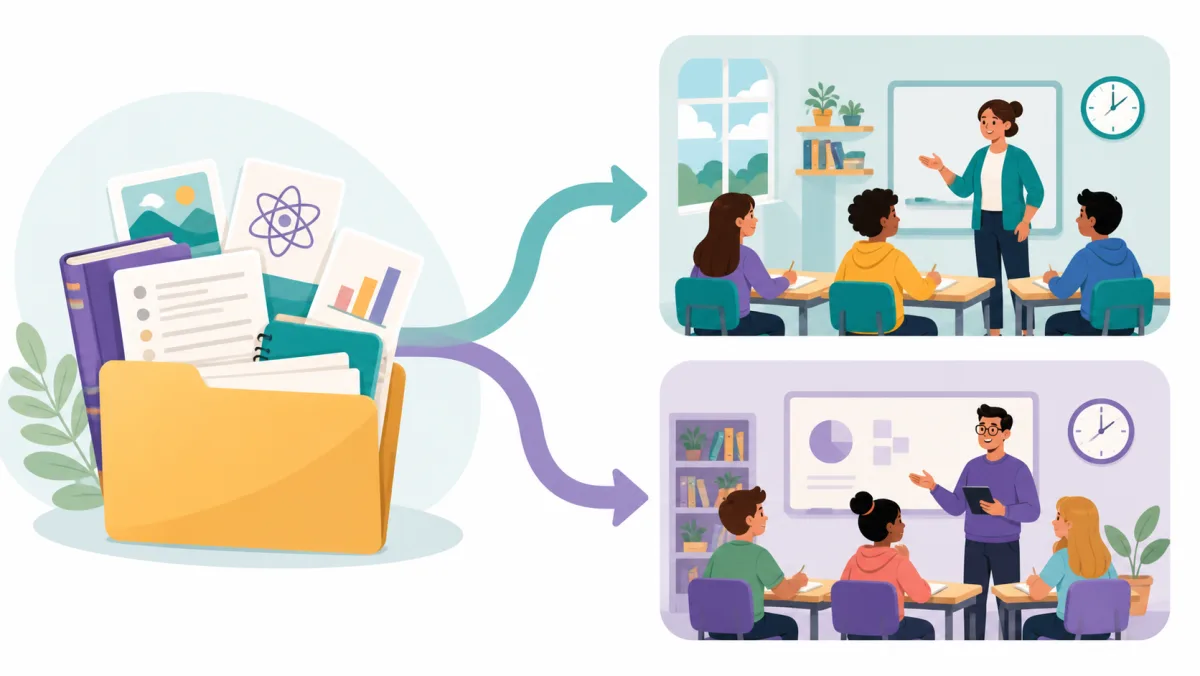
In U.S. education, a course is usually an academic offering. Class can mean the course, one meeting, its students, or a graduating group. In casual speech, Americans often use class for course.
"I'm taking a data science class."
This likely means the speaker is enrolled in a data science course.
What is a course?
A course usually has defined content, a title, and academic rules. It may also have a number and credit value. A scheduled class or section has an instructor and meeting details. Schools do not all use these labels in the same way.
"The certificate requires four courses."
"This course is worth three credits."
"I completed a course in financial modeling."
In academic records and tuition policies, course is often more precise.
What can “class” mean?
Class can refer to the same academic offering:
"I'm taking a statistics class."
It can mean one meeting:
"Class starts at 6:00 tonight."
It can mean the group of students:
"The class asked several questions."
It can also mean a cohort:
"She is in the class of 2028."
In college administration, class standing may mean first-year (freshman), sophomore, junior, or senior status. Context identifies the meaning.
Course, class, and section
A university may offer one course through several sections. Sections may meet at different times or have different instructors.
For example:
- Course: Introduction to Economics
- Section 1: Monday and Wednesday at 9:00
- Section 2: Tuesday and Thursday at 2:00
Students may call either section my economics class. Registration systems may use different labels.
A lot to take in? It is.
But Rome wasn't built in a day. Build your American workplace English one expression and cultural reference at a time—with curated explanations and structured practice in Lyra Practice.
Start a session →What might you hear at work?
"I have class after work on Tuesdays."
The colleague likely has a recurring lesson or meeting after work.
"The company will reimburse job-related courses."
This benefit may cover only approved courses, providers, or programs. Check the policy.
"We were in the same graduating class."
The speakers finished the same school or program in the same year.
"I took a class on that, but it was a few years ago."
The speaker studied the topic but is not claiming current expertise.
"The training is a three-class series."
This may mean three meetings or three separate courses. Ask when the difference matters.
What can you say naturally?
For scheduling:
"I have an online class from 6:00 to 8:00, so I need to leave by 5:30."
For professional development:
"I completed a six-week course in project finance."
For benefits:
"Does reimbursement apply per course, or to the entire certificate program?"
If someone says class and the unit matters, ask:
"Do you mean one session or the full course?"
"Is that a single course or a degree program?"
These are normal questions because class has several meanings.
What belongs on a résumé?
On a résumé, list a course when it supports your application. Relevant coursework can help students and early-career candidates. A long list may distract from stronger experience.
More precise:
"Relevant coursework: Applied Statistics, Database Systems, and Forecasting"
Potentially vague:
"Took many business classes"
For non-degree learning, name the provider and credential accurately. A short class does not necessarily show the same depth as a degree or professional certification.
Regional and institutional variation
In some forms of English, course may mean a full degree program: “I did a three-year course in engineering.” A U.S. listener may think it means one course without more context.
In the United States, you could say:
"I completed a three-year engineering program."
or:
"My degree program lasted three years."
Both versions clearly describe a full program.
Avoid status assumptions
Education can involve cost, access, and status. Do not dismiss learning from a community college or online provider. At the same time, do not present a short course as a degree.
Clear labels support both trust and fairness:
"It was a non-credit professional-development course."
For degree vocabulary, see major, minor, and degree meaning in U.S. college. For the broad word school, see when school means college or university.