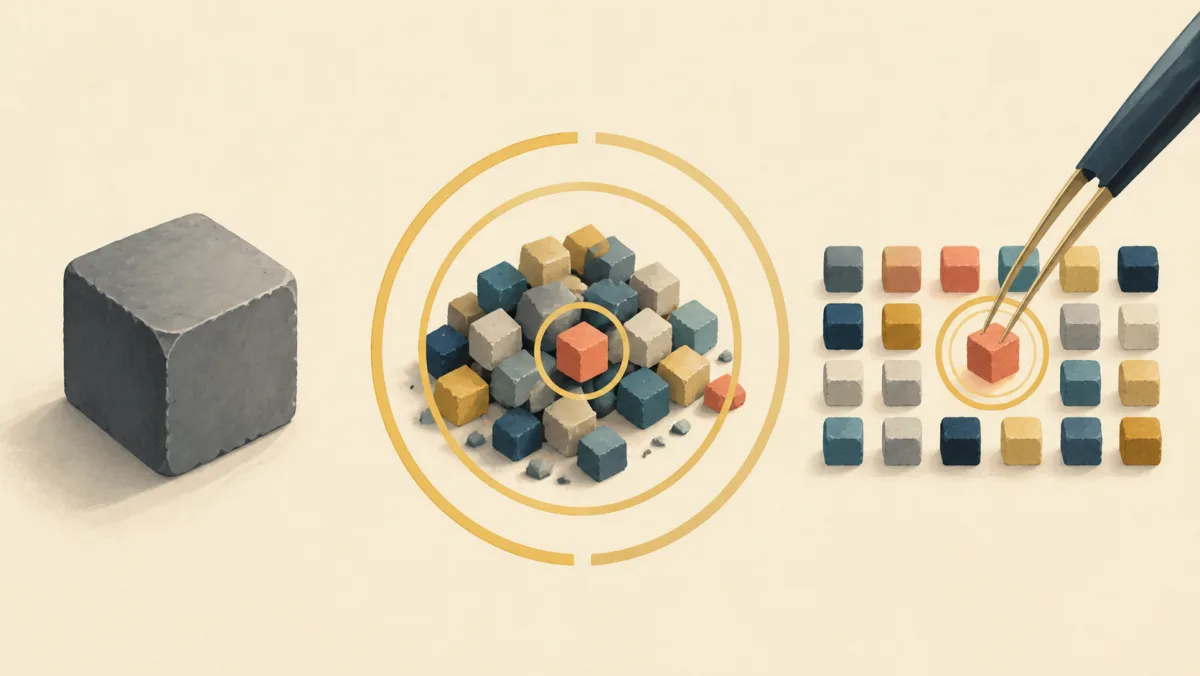
At work, granular describes a fine level of detail or control. Data may be split into smaller groups. Permissions may also apply to separate actions or resources.
Quick check
How well do you know "Granular"?
You know "Granular" well.
Keep going with the full learning path — more workplace contexts, related expressions, and practice using it yourself with feedback.
Continue with "Granular" →There's more to "Granular" than it seems.
You've got part of it, but the full learning path goes deeper into its nuances, workplace contexts, and when it sounds natural — then gives you practice using it yourself.
Learn "Granular" in depth →The move behind the word
The word often names the level of detail in a dataset or discussion. A company-wide number may hide differences. Breaking it down by region, product, group, or period can reveal them.
"The board only sees the blended retention number -- we need something more granular to see which customer segment is actually driving the drop."
"Can we get a granular breakdown of onboarding time by industry vertical? The company-wide average is hiding a real problem in one segment."
A second, less common sense: control, not just description
A second sense describes control over separate units or actions. It often appears with permissions, settings, and admin tools. For example, granular access may let one role view data but not edit it. A related article explains this control sense in more depth.
Try it yourself
Use "Granular" yourself
A literal sense used in technical fields
The word can also describe something made of grains or small particles. Granular soil, granular snow, and granular texture are natural in relevant technical fields. In general business writing, readers will usually expect the detail or control sense.
"The geotechnical report described the soil as granular" -- the unrelated literal sense, physically made of small particles, not a business metaphor.
The mistake to avoid
Do not use granular only to make detailed sound more formal. Name the dimension or control that becomes finer. In a general update, detailed or specific may be clearer when no breakdown is involved.
Why this word is worth learning carefully
Granular can be more specific than detailed. It often says that information has been split into useful parts. "We have a lot of data" differs from "we have the right breakdown." Name those parts so the request is clear.
Two mechanics, one underlying image
The detail and control senses share one image: a whole split into parts. "A granular breakdown of churn" applies that image to data. "Granular permissions for this role" applies it to access. Context shows which sense is active.
Practice scenarios
Practice using granular in situations like:
- describing a company-wide number that needs to be broken down by a named dimension
- distinguishing the descriptive sense (seeing components) from the control sense (acting on them)
- recognizing when the literal soil or particle sense fits a technical field
Useful practice phrases:
- "We need something more granular to see which segment is driving the drop."
- "Can we get a granular breakdown of this by region?"
- "That's the literal sense of granular -- we mean detailed here, not particle-sized."
Want to actually use "Granular" naturally at work?
Understanding it is one thing. Practice its nuances, see how it works in real workplace situations, and use it yourself with feedback.
Start the "Granular" learning path →The word can describe detailed information, fine control, or material made of grains.