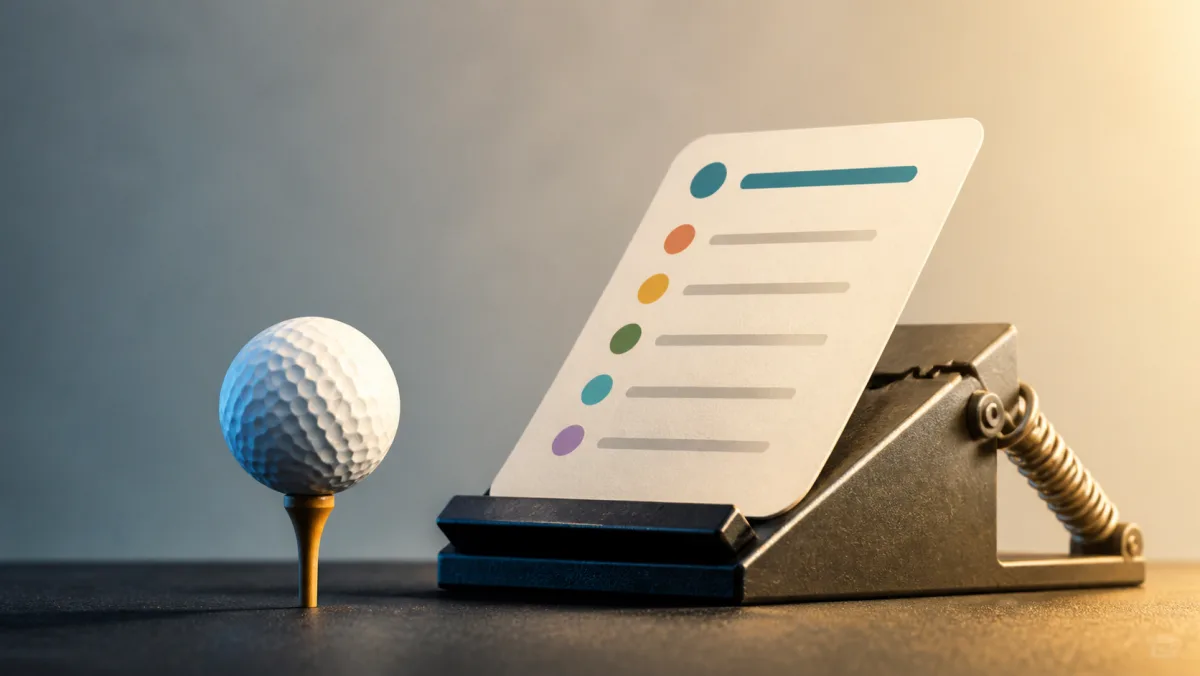
Tee up a discussion means prepare, introduce, or arrange a topic so people can discuss it productively later. It does not mean the discussion has happened or the issue has been decided.
Natural use depends on more than knowing that definition. You also need the right grammar, enough context, and a tone that fits the situation.
Ready to go beyond the quiz on "Tee Up A Discussion"?
Take the full learning path: hear it in real workplace contexts, watch short explanations, learn its nuances and when to use it, then practice using it yourself.
Start learning for free →Now see if you can use it naturally yourself.
Try it yourself
You know how to use "Tee Up A Discussion," too.
Keep going with the full learning path — more workplace contexts, related expressions, and continued practice.
Continue with "Tee Up A Discussion" →There's more to "Tee Up A Discussion" than it seems.
You've got part of it, but the full learning path goes deeper into its nuances, workplace contexts, and when it sounds natural — then gives you practice using it yourself.
Learn "Tee Up A Discussion" in depth →Start with the core workplace use
Use tee up a discussion when the situation matches the full meaning above. Avoid using it only because it sounds vivid or familiar. The expression should help the listener understand your point faster.
Common patterns
tee up a discussion about/on + topictee up a discussion for + meeting/timetee this up for + grouptee up the topic with + context/pre-readsend/circulate + material + to tee up a discussion
These patterns show the words that normally sit around the expression. Replace the placeholders with a real person, plan, issue, or time frame. Keep the structure intact when it is a fixed phrase.
Want to actually use "Tee Up A Discussion" naturally at work?
Understanding it is one thing. Practice its nuances, see how it works in real workplace situations, and use it yourself with feedback.
Start the "Tee Up A Discussion" learning path →Natural workplace examples
Example 1
“I'll circulate the analysis to tee up a discussion at Friday's meeting.”
Example 2
“Could you tee up a discussion about launch readiness for Monday?”
Example 3
“The memo tees up the topic by defining the question and options.”
Each example gives the listener a reason to accept the expression. It names the relevant action, condition, or consequence instead of leaving the phrase unsupported.
Do not use it as a loose synonym
| Nearby expression | Key difference |
|---|---|
| schedule a discussion | arrange its time and participants, without necessarily preparing its substance. |
| start a discussion | begin the live exchange. |
| facilitate a discussion | guide the exchange while it happens. |
| frame a discussion | define how the issue will be understood; one way to tee it up. |
| resolve an issue | reach an outcome rather than prepare deliberation. |
The alternatives are not always wrong. They simply make a different claim. Use the smallest claim that your facts support.
Match the tone to the setting
The golf metaphor is common in informal internal business language. In formal board, policy, or external writing, state the concrete preparatory action, such as providing background and options for discussion.
In an internal conversation, an idiom or informal label may be efficient. In a formal record, performance conversation, legal context, or client message, plain factual language is often safer. Describe what happened, who owns the next step, and what decision is needed.
A practical speaking formula
Try this sequence:
- State the situation.
- Use tee up a discussion to frame the point.
- Add the evidence or consequence.
- Ask for the next action when one is needed.
This keeps the expression useful. It also prevents the phrase from replacing the facts.
Quick self-check
Before you send or say the sentence, check that the grammar follows one of the natural patterns. Then check the intensity. Finally, ask whether your audience will understand the cultural reference or informal tone.
Use the expression when it makes the message more precise. Switch to direct wording when precision, fairness, or global clarity matters more than color.
Lyra Practice helps advanced non-native English professionals learn the nuance of high-value workplace expressions and practice using them in realistic scenarios, so their English sounds natural, precise, and senior at work. Try Lyra Practice.