
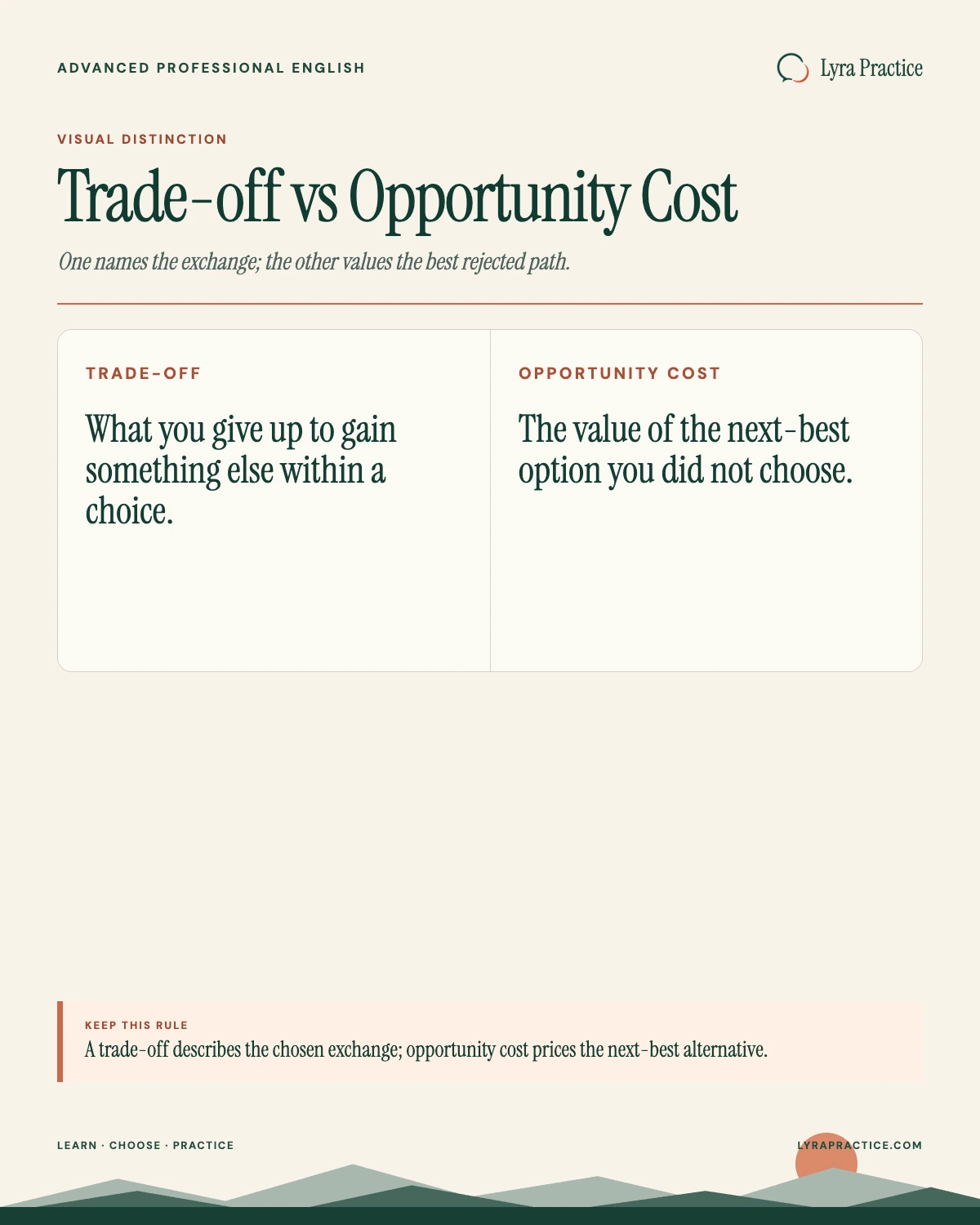
Trade-off and opportunity cost are closely related. Still, they do not name the same thing. A trade-off describes an exchange within a choice. An opportunity cost measures the best option you did not choose.
Use "trade-off" for what you give up to gain something else. Use "opportunity cost" for the value of your next-best option.
Quick check
How well do you know "Trade Off"?
You know "Trade Off" well.
Keep going with the full learning path — more workplace contexts, related expressions, and practice using it yourself with feedback.
Continue with "Trade Off" →There's more to "Trade Off" than it seems.
You've got part of it, but the full learning path goes deeper into its nuances, workplace contexts, and when it sounds natural — then gives you practice using it yourself.
Learn "Trade Off" in depth →Broad exchange versus the sharpest forgone alternative
A trade-off sentence describes an exchange. You accept less of one benefit to gain more of another. The term can cover several gains and costs in the same choice.
Opportunity cost is narrower. In economics, it is the value of the next-best option you gave up. It is not every possible benefit from every rejected option.
"The trade-off of hiring two junior engineers is more onboarding work for lower cost and more flexibility." This describes gains and costs within the choice. "The opportunity cost is the senior engineer's faster work on the delayed migration." This values the best rejected option.
The distinction also works at a strategic level. "The trade-off is growth versus margin" names an exchange. "The opportunity cost is the market share we could have gained elsewhere" names a forgone value. That second claim should point to the next-best realistic option.
Try it yourself
Use "Trade Off" yourself
Which one your sentence needs
Ask what your sentence needs to show. Use trade-off for the benefits you exchange within a choice. Use opportunity cost for the value of the best rejected path.
Do not call every downside an opportunity cost. A direct expense, delay, or risk may be part of a trade-off. It becomes an opportunity cost only when it reflects the value of the next-best use of scarce resources.
Practice scenarios
Practice choosing between trade-off and opportunity cost in situations like:
- explaining a hiring or staffing decision and what it cost and gained
- naming the specific alternative a team didn't pursue
- reviewing a strategic bet and what it forgoes elsewhere
Useful practice phrases:
- "The trade-off of [choice] is [cost] in exchange for [gain]."
- "The opportunity cost of [choice] is [specific forgone alternative]."
- "What's the single best alternative we didn't take here?"
Want to actually use "Trade Off" naturally at work?
Understanding it is one thing. Practice its nuances, see how it works in real workplace situations, and use it yourself with feedback.
Start the "Trade Off" learning path →A trade-off describes the road you took.
Opportunity cost prices the road you didn't.