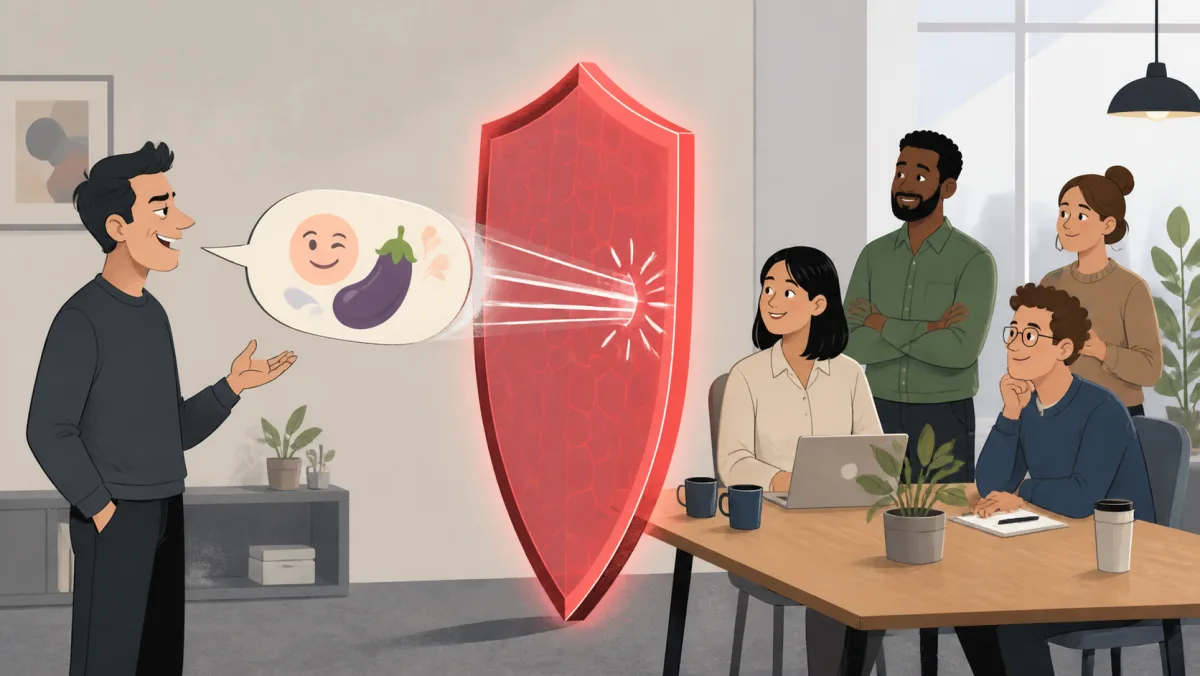
“That's what she said” turns an ordinary sentence into a sexual double meaning. It is associated with Michael Scott in the American version of The Office, although the format predates the series.
You might hear “That was harder than expected” followed by the phrase. The reply suggests that the first sentence could also describe a sexual situation.
For a non-native professional, the main lesson is recognition: someone is introducing sexual innuendo. You do not need to repeat it at work.
How does the joke work?
The phrase depends on double meaning. The original sentence has an innocent meaning in context, but a listener notices that the wording could sound sexual when imagined in another context.
Sentences involving size, length, hardness, speed, position, or physical effort can invite the response. The joke does not add useful information. Its purpose is to point out the possible innuendo.
In The Office, manager Michael Scott uses the line repeatedly. The humor often comes from his poor judgment: he says something inappropriate in professional situations and fails to respect the discomfort it creates. Peacock's guide to the series highlights the phrase as a recurring feature of the show, including in an episode involving a legal deposition.
That context is important. The character's behavior is not a model of effective management; it is often the object of the comedy.
What might you hear at work?
You may encounter the phrase in:
- informal conversations among colleagues
- messages or meme reactions
- references to The Office
- jokes after an accidentally suggestive sentence
- criticism of someone behaving like Michael Scott
Someone may also stop before saying it:
"I could make a The Office joke here, but I won't."
That sentence signals that they noticed the double meaning and chose not to introduce sexual humor.
If a colleague mentions “a Michael Scott joke,” they may mean this kind of predictable innuendo. Someone might also say “Don't make the obvious joke” when they notice the double meaning and want the conversation to stay professional.
Why is it risky at work?
The phrase sexualizes another person's words without their invitation. Even when the speaker intends harmless humor, it can create embarrassment or make the conversation feel less professional.
Risk increases when:
- a manager says it to a direct report
- the target has already shown discomfort
- the joke is repeated
- the conversation includes clients or customers
- it appears in a recorded or written channel
- people cannot easily leave the situation
- the workplace has clear policies about sexual comments
A lot to take in? It is.
But Rome wasn't built in a day. Build your American workplace English one expression and cultural reference at a time—with curated explanations and structured practice in Lyra Practice.
Start a session →Norms vary across teams, regions, and relationships, but familiarity with a group does not guarantee that every person welcomes the joke. Laughter can also reflect surprise or social pressure rather than comfort.
Recognition is not permission to produce it
Understanding a joke helps you follow the conversation. It does not require you to join in.
If someone uses the phrase, you can simply let the moment pass and return to the topic:
"Anyway, the installation took two hours. What is the next step?"
If you missed the meaning and need to understand, asking a trusted person privately may be easier than requesting an explanation in the meeting:
"I think I missed a reference earlier. Was that a joke from The Office?"
If the joke is directed at you and you want it to stop, several levels of response are available:
"Let's keep this professional."
"I'd rather not turn my comment into a sexual joke."
"Please don't make that joke about what I say."
You do not need to smile or produce a clever answer.
What can you safely say instead?
If you notice an accidental double meaning, ignoring it is usually the safest option. Continue with the intended business meaning:
"Yes, the review was harder than expected. Which part caused the delay?"
If you want light humor, choose humor that does not sexualize a colleague:
"That sentence sounded more dramatic than I intended."
"Let me rephrase that before it becomes the meeting's headline."
These responses acknowledge awkward wording without making another person the subject of sexual innuendo.
What if everyone on the team uses it?
A close group may treat the phrase as familiar, predictable humor. Even then, workplace membership changes, and a new colleague may not share the same expectations. Written messages can also travel beyond their original audience.
Before repeating a joke, consider not only “Will people understand it?” but also:
- Does it introduce sexual content?
- Is there a power imbalance?
- Could someone reasonably feel targeted?
- Would the message be comfortable if forwarded?
- Does the joke help the relationship enough to justify the risk?
For this phrase, the practical answer is often to recognize it and not produce it.
A useful cultural distinction
Knowing that the joke is associated with The Office can prevent a second misunderstanding. A speaker may be imitating an intentionally inappropriate fictional boss rather than presenting the phrase as normal professional English.
The same principle applies to other character-based references: what makes a scene funny may be exactly what makes the behavior unsuitable at work.
For a coercion-related line that also deserves caution, see what “an offer you can't refuse” means. For strategies when a group uses references you do not know, see how to handle cultural references in English at work.