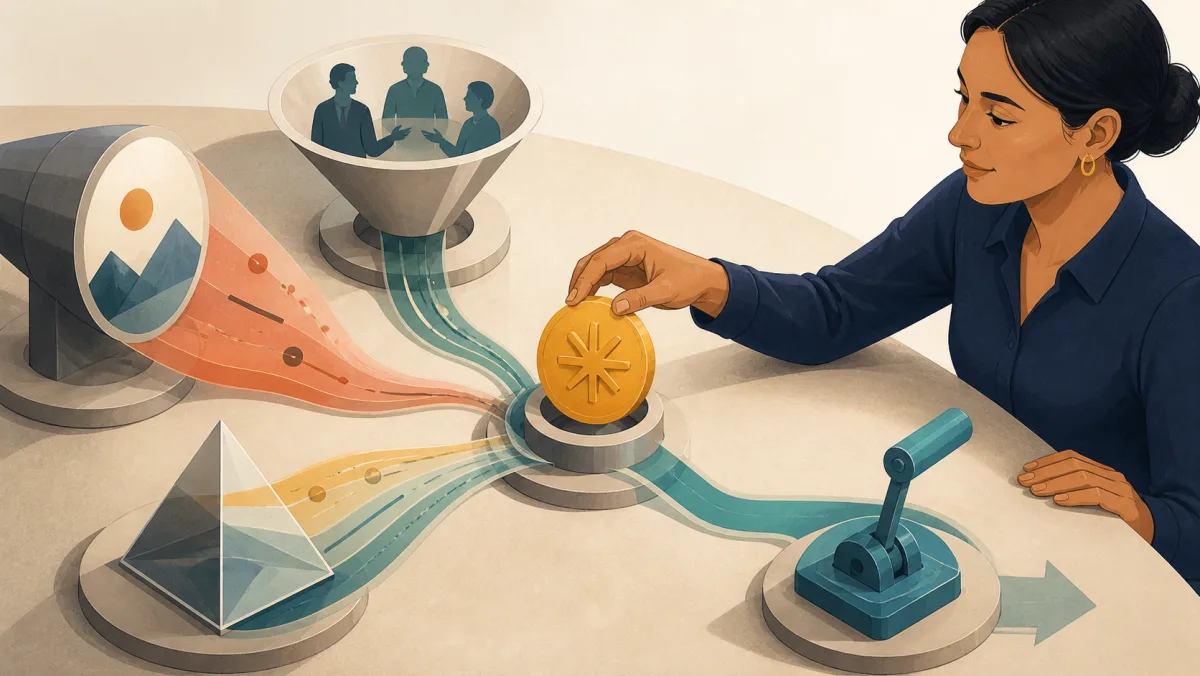
A takeaway is a main point, lesson, or impression someone keeps. These eleven examples show how the noun works across common workplace settings.
Quick check
How well do you know "Takeaway"?
You used "Takeaway" well.
Check your broader workplace vocabulary to find the expressions worth practicing next.
Find my vocabulary gaps →There is more to "Takeaway" than it seems.
The free assessment can show you which workplace expressions need more attention.
Take the free assessment →Retrospective, personal reflection
"My biggest takeaway from the client call was that price isn't actually the deciding factor — response time is."
This names one important point kept from the call, not a full recap.
"My takeaway from the survey is that onboarding friction is losing us early adopters, though we should validate that with more data."
My takeaway marks this as the speaker's interpretation, while the finding sounds more like a direct result from the data.
Informal and quick
"Quick takeaway from the demo: the search feature is the one thing everyone asked about."
This brief form fits a chat message or quick meeting comment.
Structured written list
"Key Takeaways: 1) Churn dropped 12% in Q2. 2) Support tickets are increasingly about billing, not bugs. 3) The new pricing page converts better on mobile than desktop."
Key Takeaways is a common heading for several clear, distinct points.
Try it yourself
Use "Takeaway" yourself
Naming the audience
"The takeaway for leadership is that we need a second approver on vendor contracts above $50k."
For names the audience or group that needs the point, while from usually names its source.
Prospective, designing the message
"Before we present this to the board, we should agree on what we want their takeaway to be."
Here, the team plans what the audience should remember instead of reporting a past response.
"Our key message was that the rollout is on track, but the team's actual takeaway was that leadership is worried."
This sentence shows how the intended message and the audience's takeaway can differ.
Precision: one point vs. several
"There were three separate takeaways from the audit, not one — cost, timing, and vendor risk all need attention."
Use the plural takeaways for several distinct points. The main takeaway can highlight one point without denying that others exist.
The action-item boundary
"The takeaway is that our onboarding is too slow; the action item is to cut the setup flow from nine steps to four."
A takeaway is what someone learned or concluded, while an action item is a task.
Training and client contexts
"New hires should leave the first week with one clear takeaway: ask questions early, not after they've built the wrong thing."
"The client's takeaway from the pitch was that we understand their compliance constraints better than our competitors do."
These onboarding and sales examples each name a clear point to remember.
Practice scenarios
Practice using takeaway in situations like:
- stating your own takeaway after a meeting, demo, or presentation
- structuring a written "Key Takeaways" list with two or three distinct points
- deciding what you want an audience's takeaway to be before you present
- separating a takeaway from the action items in the same document
Useful practice phrases:
- "My takeaway from [X] is that [clause]."
- "Key Takeaways: 1) ... 2) ... 3) ..."
- "The takeaway for [audience] is that [clause]."
- "The takeaway is [X]; the action item is [Y]."
Want to get better at distinctions like this?
Lyra Practice helps you learn the nuance of high-value workplace expressions, then practice using them in realistic situations.
See how Lyra Practice works →Natural uses usually state the lesson or conclusion. Avoid leaving the reader to guess what the takeaway is.