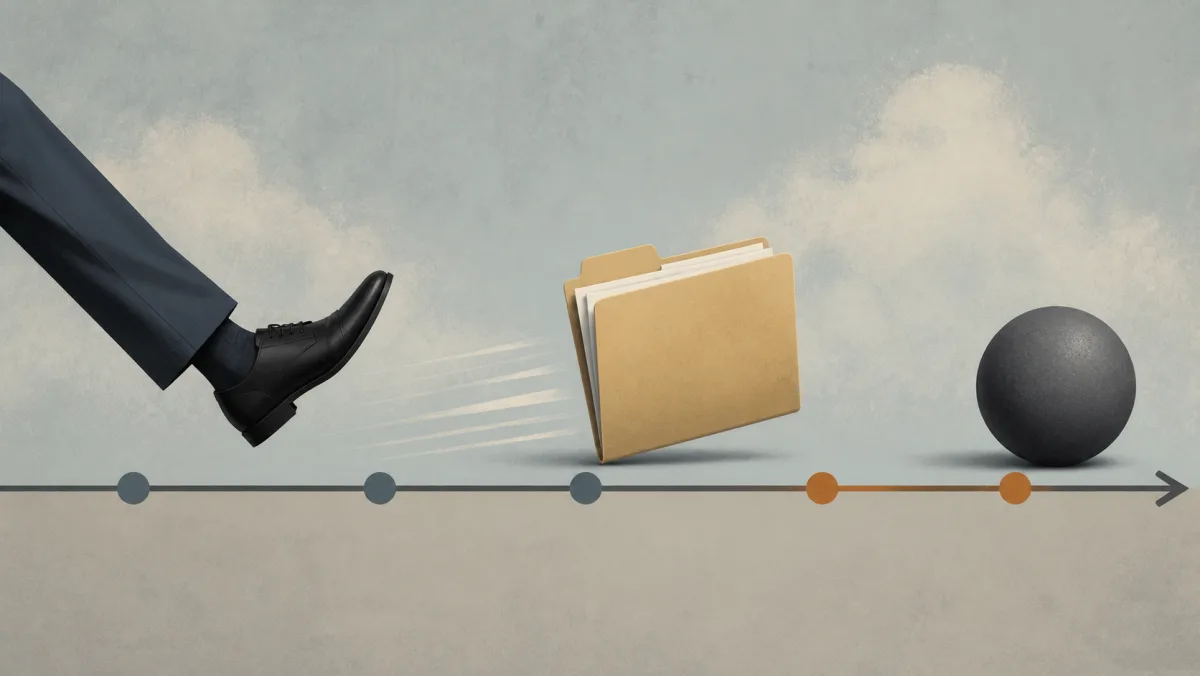
Informally postpone a decision or unresolved question because the timing, information, readiness, or ownership is not sufficient yet.
The examples below show the expression in realistic workplace contexts. They also show the grammar around it, not only the definition.
Ready to go beyond the quiz on "Punt On A Decision"?
Take the full learning path: hear it in real workplace contexts, watch short explanations, learn its nuances and when to use it, then practice using it yourself.
Start learning for free →Now see if you can use it naturally yourself.
Try it yourself
You know how to use "Punt On A Decision," too.
Keep going with the full learning path — more workplace contexts, related expressions, and continued practice.
Continue with "Punt On A Decision" →There's more to "Punt On A Decision" than it seems.
You've got part of it, but the full learning path goes deeper into its nuances, workplace contexts, and when it sounds natural — then gives you practice using it yourself.
Learn "Punt On A Decision" in depth →Natural examples
Example 1
“Let’s punt on the vendor decision until the security review is complete.”
Example 2
“We punted on the pricing question because the forecast was not ready.”
Example 3
“If we punt on it again, we should name an owner and a date.”
Example 4
“We should punt on the pricing choice until demand is clearer.”
Example 5
“Let’s punt on the launch decision until Thursday, when Finance will share the forecast.”
Example 6
“We’ll punt on the integration question until the test is complete.”
Example 7
“Let’s punt on the decision until Tuesday; I’ll bring the missing forecast and make the recommendation then.”
Example 8
“Let’s punt on the hiring decision until Friday, when the budget forecast is ready.”
Example 9
“We’ll punt on the rollout decision today, and I’ll return with a recommendation after Thursday’s test.”
Want to actually use "Punt On A Decision" naturally at work?
Understanding it is one thing. Practice its nuances, see how it works in real workplace situations, and use it yourself with feedback.
Start the "Punt On A Decision" learning path →More ways to build the sentence
These are the main patterns to practice:
punt on a/the decisionpunt on the question / choice / issuepunt on it for nowpunt on + object + until + checkpointkeep punting on + object
Use the pattern that matches your message. Do not force the expression into every sentence. A direct description is often better when the stakes are high or the audience may not know the phrase.
What the sentence needs to make clear
A strong sentence gives enough context for the listener to understand why the expression fits. Name the plan, behavior, decision, or result you mean. If the phrase contains criticism, connect it to observable facts rather than using it as a label.
Compare these nearby choices:
| Choice | What it adds |
|---|---|
| make / call a decision | choose now. |
| delegate | transfer decision authority to someone else. |
| decline / reject | make a final negative choice. |
| defer / postpone | clearer, more formal ways to delay. |
| table | can mean postpone in US English but present for discussion elsewhere. |
These terms may describe the same situation from different angles. Choose the one that matches the point you need to make.
Tone and audience
Punt on is informal; it can neutrally describe deliberate deferral or sound critical when it suggests repeated avoidance or weak ownership.
Before using the expression, ask three questions:
- Does the sentence match the expression's real meaning?
- Is the tone suitable for this person and setting?
- Would a plain description be clearer or fairer?
Practice it aloud
Start with one of the common patterns. Add a real but non-confidential workplace situation. Then say the sentence once in a direct version and once in a softer version. This helps you control both meaning and tone.
The goal is not to memorize one example. It is to build a sentence that makes the meaning, evidence, and tone clear.
Lyra Practice helps advanced non-native English professionals learn the nuance of high-value workplace expressions and practice using them in realistic scenarios, so their English sounds natural, precise, and senior at work. Try Lyra Practice.