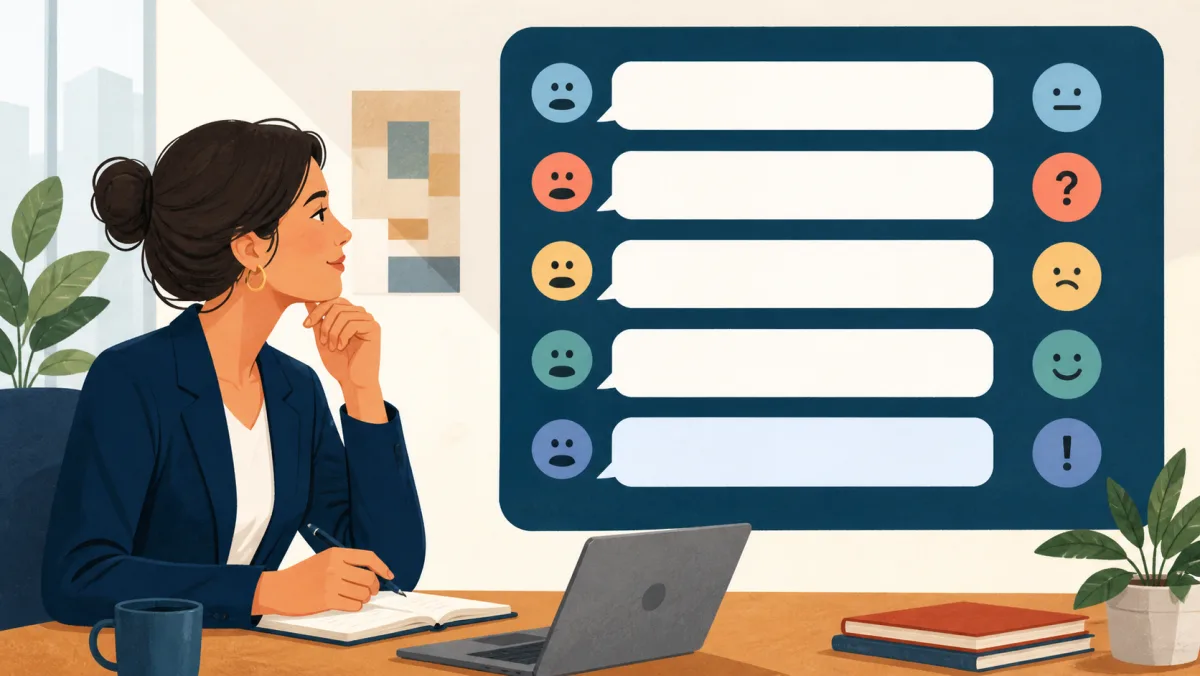
Workplace chat lacks many cues from speech, such as voice and facial expression. Readers may use punctuation, emoji, and message length to infer tone. These clues are uncertain and not universal.
A period does not prove anger. A thumbs-up does not always mean enthusiastic agreement.
Periods can feel final—or simply grammatical
Compare:
“Sounds good”
“Sounds good.”
Some readers find a period in a short chat message firm or cold. Others see normal grammar. Age, region, language, platform habits, relationships, and context can all shape the reading.
Do not infer conflict from one period. If the decision matters, confirm the decision instead of guessing about mood.
Exclamation marks add energy
“Thanks!”
“Great work!”
An exclamation mark may make a short note feel warmer or more eager. Several marks may feel intense or too casual in some settings:
“Please send this today!!!”
That version may also add pressure. One mark is often enough, but local style and context still matter.
Ellipses are highly ambiguous
“Okay…”
The dots may suggest doubt, an unfinished thought, or a pause. They may also be a personal or regional writing habit with no negative intent.
If you mean that a decision is incomplete, say so:
“Okay—I can proceed once finance confirms the amount.”
Understanding is only the first step.
Lyra Practice helps you retrieve and use high-value workplace expressions in realistic situations until they feel natural.
Start a practice session →Emoji can clarify or complicate indirect meaning
A smile, laugh, or worried face may guide the reading. It can also create doubt because people use the same symbol in different ways.
Use emoji as optional tone support, not as the only carrier of a critical message:
“The deployment failed again 😅”
The emoji may make the note feel lighter. It does not state severity, ownership, or next steps. Add those facts in words.
Reactions are not always approval
A thumbs-up reaction may mean:
- I saw this.
- I agree.
- I will do it.
- Thank you.
- No further response is needed.
If you need a commitment, ask for it in words:
“Please confirm by noon whether you can own the review.”
A reaction may only show that the person saw the request. It does not always show consent, approval, or ownership.
Match the relationship and channel
Emoji may be normal in team chat but out of place in a formal incident report. Client preferences vary. Follow written policy for legal, regulated, or public records.
Avoid assuming that informality creates closeness or that formality creates hostility.
Use words for sensitive meaning
For feedback, deadlines, performance, money, safety, or conflict, use clear words:
“I agree with the direction, but I’m concerned about the Friday deadline.”
“I received the request. I can confirm ownership after I review my capacity.”
This reduces the need to decode your mood. Clear wording still does not prove that both people agree.
Respond to ambiguity with a neutral check
Instead of “Why are you angry?”, ask:
“Just checking: are we approved to proceed?”
“Did you want changes, or was that an acknowledgment?”
“I may be reading too much into the short reply. Is there a concern we should discuss?”
Use the last version only when it is safe and useful to discuss tone. A private channel may fit personal feedback better than a group chat.
Practice plain and warm versions
Write one message in three forms:
- concise and neutral
- warm but professional
- formal and explicit
Then remove each emoji and check whether the core meaning remains. Add tone clues only after the message is clear.
For channel transfer, read How to Practice One Expression Across Email, Chat, and Meetings and How to Sound Natural in Workplace Chat.
Create lightweight team norms
Teams can reduce doubt by defining common reactions. A check mark may mean “complete,” while eyes may mean “I’m reviewing.” Record these norms and make them easy to find.
Norms also help with urgent messages:
“For production incidents, tag the on-call person and state the severity. Do not rely on an emoji reaction as acknowledgment.”
Do not regulate every friendly punctuation choice. The goal is sound coordination, not one writing style. Agree on signals where doubt creates work or risk.
New employees should be free to ask what a reaction means. No emoji or punctuation rule is universal across regions, languages, ages, and teams.