
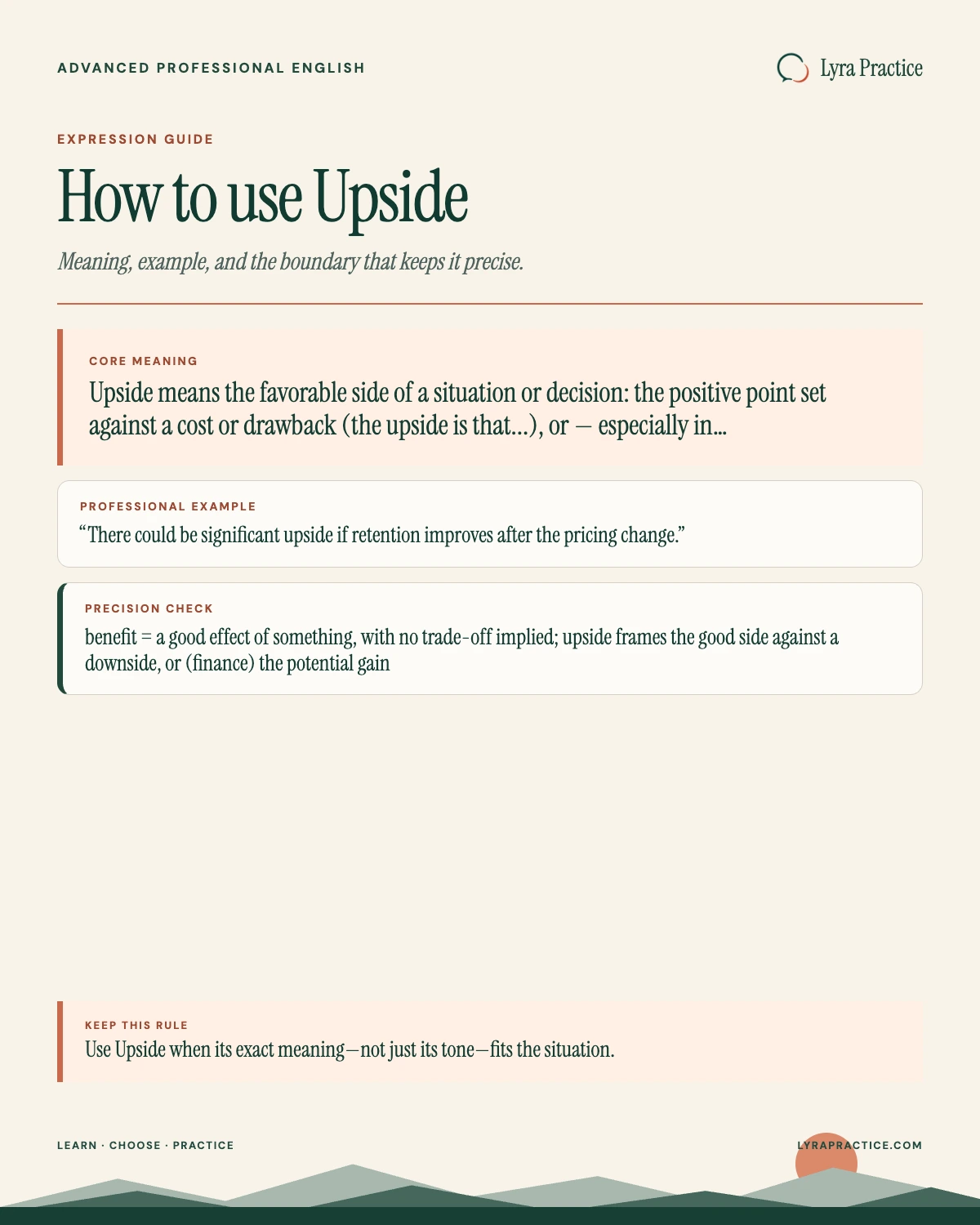
Upside names a possible benefit or gain. It often appears when the result is uncertain. The word can name the benefit itself or its possible size. "There's upside" may be too vague for a decision. "There's significant upside if we win the enterprise segment" says more. It gives a size and a condition.
Quick check
How well do you know "Upside"?
You know "Upside" well.
Keep going with the full learning path — more workplace contexts, related expressions, and practice using it yourself with feedback.
Continue with "Upside" →There's more to "Upside" than it seems.
You've got part of it, but the full learning path goes deeper into its nuances, workplace contexts, and when it sounds natural — then gives you practice using it yourself.
Learn "Upside" in depth →The grammar pattern
Upside has both uncountable and countable uses. Size words often go with the uncountable form: significant upside, limited upside, unlimited upside. This form needs no article. For one specific benefit, use an upside, the upside, or the only upside. The plural "upsides" is also natural, often beside downsides. In this business sense, upside functions as a noun. Do not use "upside" as a verb (*to upside the plan). Also avoid using it as an adjective after "is" (*that's very upside).
The prepositions matter. the upside of/to [something] points to its possible benefit. For example, say "the upside of a phased rollout." upside for [beneficiary] says who may benefit. One example is "upside for a top performer." In finance, upside in [a market or asset] often means room for its value to rise. For example, "we still see upside in the stock." Do not treat "in" as a general substitute for "of" or "to."
Worked examples
Investor or client note (formal): "There is significant upside if adoption accelerates in the next two quarters, though that depends on pricing holding." This gives both a size and a condition. It does more than call the outlook "good."
Slack message, softening a setback (informal): "On the upside, the vendor issue forced us to finally document the handoff process properly." The set phrase introduces a good part after naming a setback.
Risk/reward memo (a common pattern): "The downside is a slower rollout, while the upside is far fewer support tickets once it's live." Putting upside beside downside makes the trade-off clear.
Try it yourself
Use "Upside" yourself
The two mistakes that matter most
Vague hype with no size or reason. "There's a lot of upside" gives little support on its own. In an analysis, add a size, a reason, or a condition. Ask: how much, and what does it depend on?
Telling only one side. Some decisions need a full risk-and-reward view. In those cases, naming only the upside can sound like a sales pitch. Naming only the downside can also distort the choice. Put both sides together when both matter to the decision.
A third risk is using upside as if it named a feeling. You can weigh, judge, or measure upside. A person may feel optimistic. "I'm feeling a lot of upside about this quarter" is not a natural business use.
Practice scenarios
Practice using upside in situations like:
- sizing a possible gain in an investment, deal, or market entry with a magnitude and a driver
- softening a setback in a Slack message or status update with "on the upside"
- writing a risk/reward memo that names upside and downside together
- describing a candidate's or hire's future potential with supporting evidence
Useful practice phrases:
- "There's significant upside if [condition]."
- "On the upside, [redeeming point]."
- "The downside is [X], while the upside is [Y]."
- "[Person] has real upside as [role], because [evidence]."
Want to actually use "Upside" naturally at work?
Understanding it is one thing. Practice its nuances, see how it works in real workplace situations, and use it yourself with feedback.
Start the "Upside" learning path →Using upside well means explaining a possible gain, not just praising it.
Pair it with the downside when a decision needs both sides. That keeps the analysis clear.