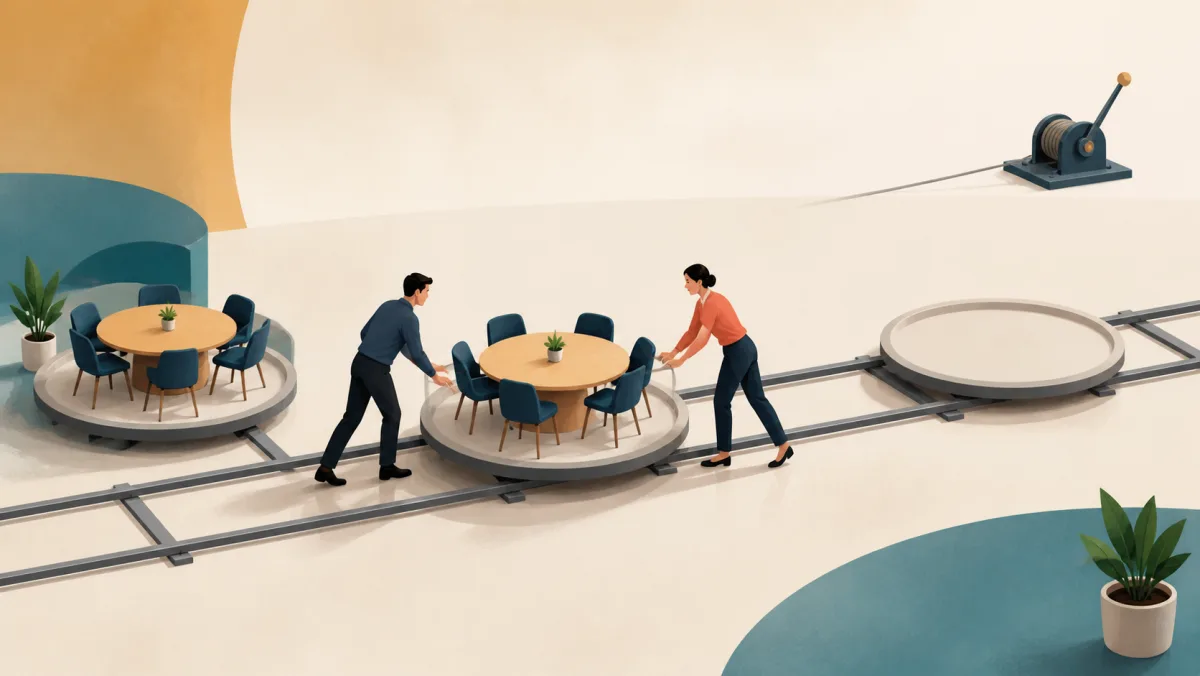
Push a meeting back has two reliable active patterns for noun objects: "push + object + back + to/until/by" and "push + back + object + to/until/by." Pronouns must split the phrase, as in "push it back." The passive construction also works: has been pushed back to/until...
Quick check
Choose the scheduling grammar
You know "Push Back" well.
Keep going with the full learning path — more workplace contexts, related expressions, and practice using it yourself with feedback.
Continue with "Push Back" →There's more to "Push Back" than it seems.
You've got part of it, but the full learning path goes deeper into its nuances, workplace contexts, and when it sounds natural — then gives you practice using it yourself.
Learn "Push Back" in depth →Active and passive both work, for different notes
This pattern works in active and passive voice. Both constructions are useful in status updates and calendar notes. Sometimes you move the meeting yourself, while other times you report someone else's schedule change.
"We had to push the steering committee meeting back by two weeks."
This active version identifies the person or group that made the decision. Sometimes, the sentence identifies them only as "we."
"The steering committee review has been pushed back until Friday because the finance model is not ready yet."
This passive version emphasizes the meeting and its new date. It does not emphasize who decided. Use it when the reason matters more than the decision-maker, or when that person's identity is unnecessary.
Try it yourself
Write the rescheduling note
The common mistake: adding "on"
Don't add "on." The wording "push back on the meeting to Friday" combines two grammatical patterns. One pattern covers scheduling, while the other covers disagreement. Readers may interpret your logistics note as a challenge to a review that you only meant to move.
The correction is simple once you see the difference. "On" belongs to the disagreement meaning, as in "push back on the assumption." It does not belong in the scheduling pattern. When rescheduling a date, remove on entirely. Say "push the meeting back to Friday" or "push back the meeting to Friday" — not "push back on the meeting to Friday." Put a pronoun object between "push" and "back."
Two patterns, two purposes
Keep the two patterns separate in your mind. For schedules, use push + [object] + back + [to/until/by] + [time]; a noun object may also follow back. For disagreement, use push back + on + [object]. A pronoun schedule object sits between "push" and "back," while the disagreement object comes after "on."
Mixing these patterns makes a sentence confusing, not merely awkward. "Push back on the meeting to Friday" can suggest two actions at once. It sounds like someone resists the meeting while also rescheduling it. The reader must interpret what you meant and may guess incorrectly in a fast thread.
Try this quick check before sending a calendar note. Read the sentence again and look for "on" immediately after "push back." If it appears, remove it when you only intend to reschedule a date.
This rule is small, but it helps when time is short. In a Slack thread or invite, you may quickly add "on" because it appears in many other uses of "push back." You do not need a long list of exceptions. Just remember that a pronoun object goes inside the phrase, while a noun object may also follow "back."
Practice scenarios
Practice using push back in these situations.
- writing a calendar note that moves a meeting without sounding like you're objecting to it
- reporting a schedule change someone else made, in passive voice
- catching the 'on' error before it changes the meaning of a logistics message
Try these useful practice phrases.
- "We had to push [the meeting] back by..."
- "[The meeting] has been pushed back until... because..."
- "Push [the meeting] back to [date]"
Want to actually use "Push Back" naturally at work?
Understanding it is one thing. Practice its nuances, see how it works in real workplace situations, and use it yourself with feedback.
Start the "Push Back" learning path →Pronoun objects sit between push and back. Noun objects may follow back.
One extra preposition can make a schedule note sound like an objection.