
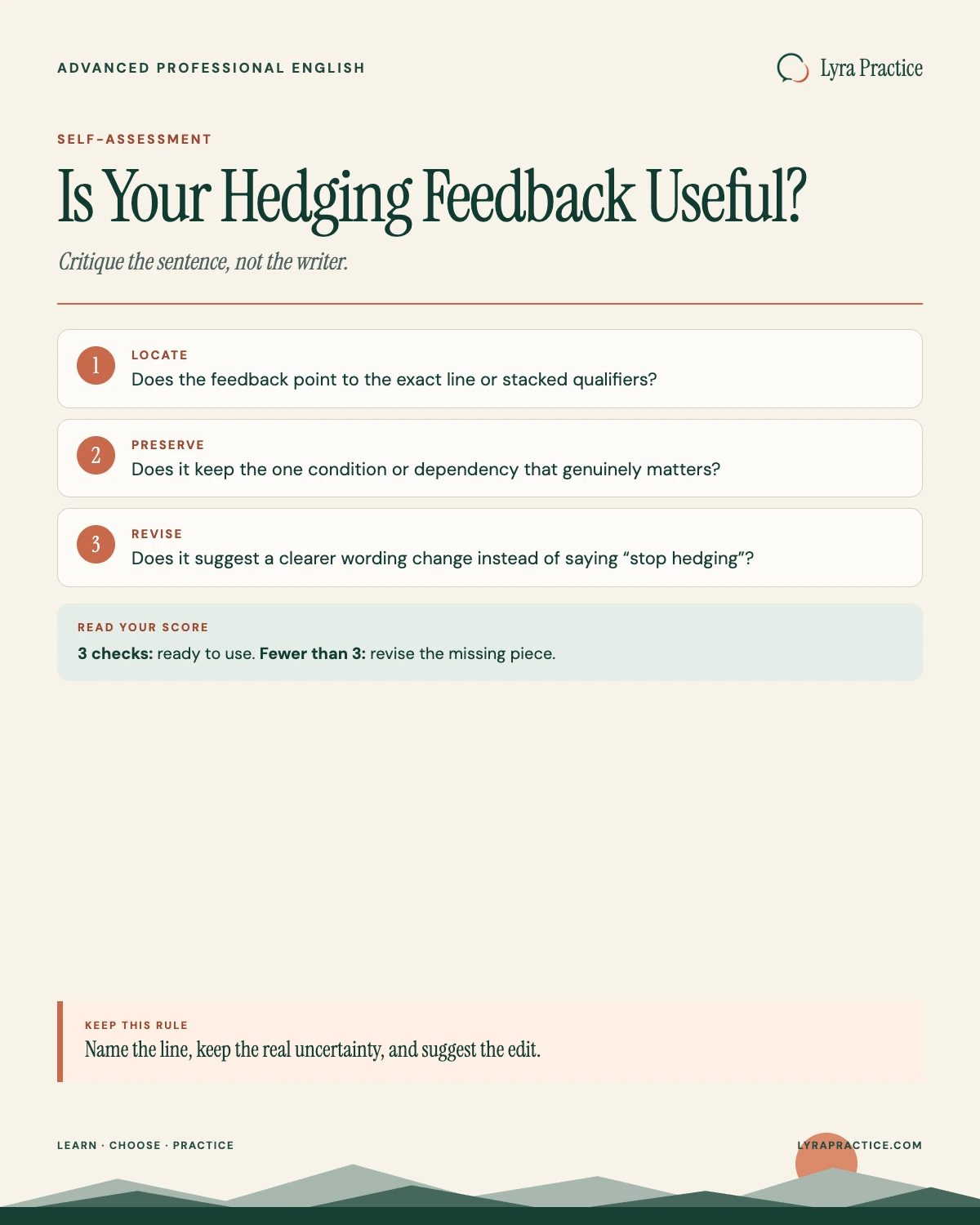
"You're hedging too much in this update, just commit to something." The main point may be fair, but the feedback is still vague and too personal.
Blunt notes such as "you are hedging" or "stop hedging" can judge the writer rather than the text, even when the writer is merely careful about a real unknown. Give clear advice about the words on the page; do not guess at the person's aim or label their style.
Quick check
Which feedback is constructive
You know "Hedge" well.
Keep going with the full learning path — more workplace contexts, related expressions, and practice using it yourself with feedback.
Continue with "Hedge" →There's more to "Hedge" than it seems.
You've got part of it, but the full learning path goes deeper into its nuances, workplace contexts, and when it sounds natural — then gives you practice using it yourself.
Learn "Hedge" in depth →Why the blunt version lands badly
"Hedging" can mean due care, but it can also imply a wish to evade, so a blunt label may make the writer seem false when the doubt is real. Name the exact issue instead: it may be too many limits in one line, or it may be a key condition that is missing. Focus on the text, not the person's character.
"You're hedging too much in this update, just commit to something" is harsh and vague because it does not show where to edit. "This paragraph has three separate qualifiers stacked together — can you pick the one condition that actually matters and state the rest more directly?" points to a clear fix without judging the writer's aim. "The launch date reads as fully confident, but I know we still have that vendor dependency open — worth naming it so the risk is visible?" solves the reverse issue by asking for due care without blame.
The mistake to avoid
Avoid blunt feedback such as "stop hedging." It can sound like a claim about the writer's character and may harm trust, even when the main point is fair. The writer learns that something is wrong but not what, so the next draft may sound too sure and may still miss the real issue.
Clear feedback is not just more fair; it also leads to a better draft because it points to the exact line and issue. The writer does not have to guess what "less hedgy" means or assume that all signs of doubt are bad. This is more useful than calling all care "hedging."
Try it yourself
Comment on the text, not the person
Practice scenarios
Practice giving constructive feedback about hedged writing in situations like:
- pointing out stacked qualifiers in a paragraph without labeling the writer as evasive
- flagging underhedged writing that omits a known risk, without suggesting the writer was careless
- rewriting a blunt "stop hedging" note into a specific, actionable suggestion
Useful practice phrases:
- "Can you pick the one condition that actually matters here?"
- "I know we have [dependency] open — worth naming it in this update?"
- "Instead of 'stop hedging,' let's look at this specific sentence."
Want to actually use "Hedge" naturally at work?
Understanding it is one thing. Practice its nuances, see how it works in real workplace situations, and use it yourself with feedback.
Start the "Hedge" learning path →"Stop hedging" only says there is a problem, while naming the line and key condition shows what to change.
That second kind of feedback leads to a better draft and avoids vague claims of "overhedging."