
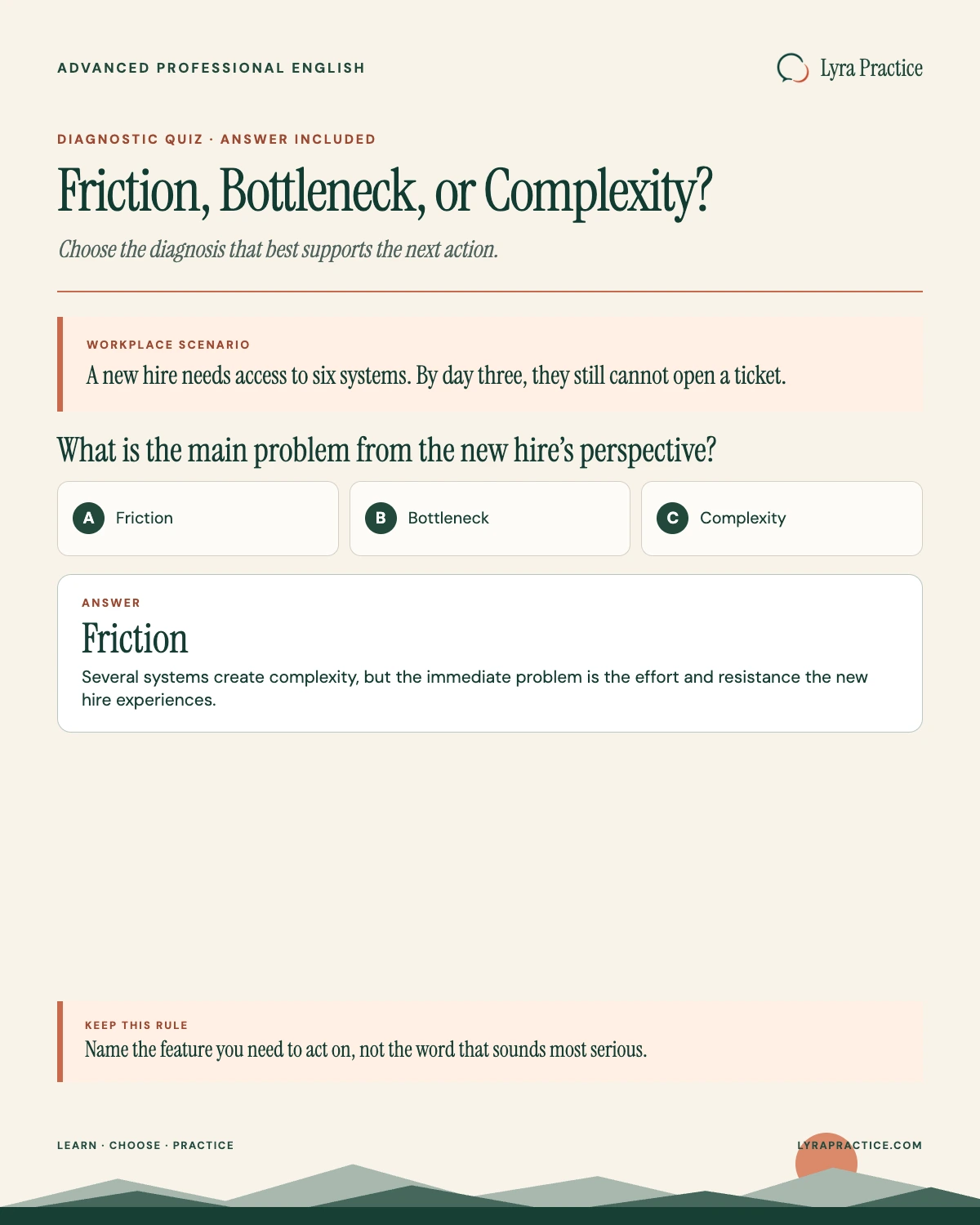
Three short workplace scenarios appear below. Read the evidence in each one. Then choose the most useful diagnosis: friction, bottleneck, overhead, delay, or complexity.
Why these five keep getting confused
These words can point to related problems. Friction is effort or resistance within an experience or process. A bottleneck is a stage whose limited capacity holds back the flow. Overhead is ongoing work or cost needed to operate. A delay means something happens later than planned or expected. Complexity comes from many parts, rules, or links that are hard to manage.
More than one word may describe a situation. Choose the word that best supports the action you want to take.
Try it yourself
Diagnose repeated workflow resistance
Test yourself: three scenarios
Scenario 1: "A shared spreadsheet has to be manually reconciled by one specific analyst every Friday before anyone else can see updated numbers -- no matter how much data comes in during the week, only that one reconciliation can happen."
What's the diagnosis? Bottleneck -- the weekly review is a capacity limit. It holds back every later step. A delay is present too, but bottleneck names its cause.
Scenario 2: "The team keeps a part-time contractor on retainer just to keep the shared component library from drifting out of sync with the design system."
What's the diagnosis? Overhead -- the retainer can be viewed as an ongoing cost of upkeep. The sentence does not describe a blocked stage or one hard interaction.
Scenario 3: "A new hire's first week involves six separate systems to get access to -- email, VPN, the ticketing tool, payroll, the design library, and the shared drive -- and by day three they still haven't been able to open a single ticket."
What's the diagnosis? Friction is the main focus. Six systems do create complexity. Yet the immediate problem is the effort of gaining access. The three-day wait is also a delay. Friction directs attention to the new hire's experience.
The trap to watch for
Do not pick the word that sounds most serious. Also, do not choose "friction" only because this guide teaches it. Several labels can be true at once. Start with the problem you need to explain. Is one stage limiting flow? Is there an ongoing cost? Is the issue lateness, many linked parts, or effort within the process? Your answer should point to evidence and a useful next step.
Practicing the full neighborhood
Study all five together instead of learning only pairs. The useful skill is choosing a main diagnosis when several words apply. Explain why your choice fits the current goal.
Practice scenarios
Practice using friction in situations like:
- diagnosing the right word for a workplace scenario across all five neighbors
- ruling out the other four words with a specific, statable reason each time
- resisting the urge to default to 'friction' just because it's the word being taught
Useful practice phrases:
- "That's a bottleneck, not friction -- one stage caps everything downstream."
- "That's overhead, not friction -- it's a standing cost, not a speed claim."
- "That's mainly friction, not just complexity -- the effort is what the person actually feels."
Want to actually use "Friction" naturally at work?
Understanding it is one thing. Practice its nuances, see how it works in real workplace situations, and use it yourself with feedback.
Start the "Friction" learning path →Five words offer five different views of a problem. Evidence and purpose decide which view is most useful.