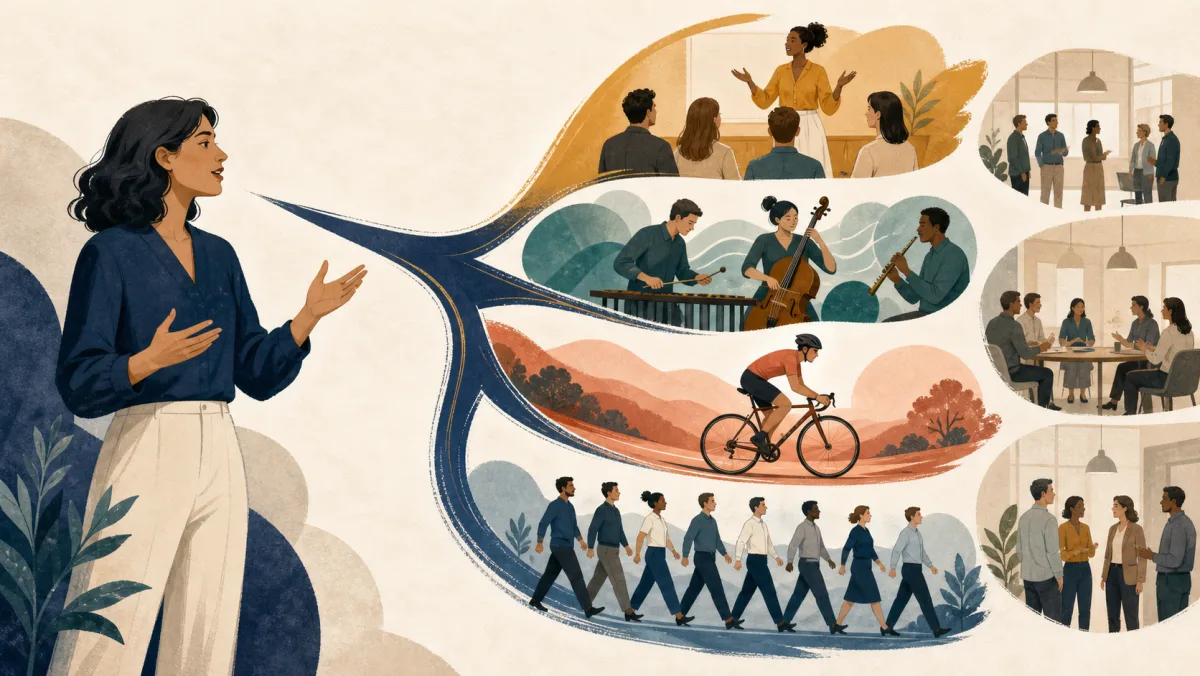
Cadence has several meanings outside the office. Recognizing them helps you interpret the word accurately.
No. "Cadence" can mean the rhythm of speech or prose ("vary your cadence when presenting"). It can also mean a set of chords in music or a pedal or step rate in sport. Another meaning is a marching chant. None means a repeated work practice, and the speech sense appears most often in ordinary workplace conversation.
Quick check
Recognize broader patterned timing?
You know "Cadence" well.
Keep going with the full learning path — more workplace contexts, related expressions, and practice using it yourself with feedback.
Continue with "Cadence" →There's more to "Cadence" than it seems.
You've got part of it, but the full learning path goes deeper into its nuances, workplace contexts, and when it sounds natural — then gives you practice using it yourself.
Learn "Cadence" in depth →The one other meaning that shows up at work
A coach who says "vary your cadence" means the rhythm of your voice, not your meeting plan. Vocal rhythm matters at work, but it is not a repeated work pattern.
Delivery sense (workplace-adjacent): "The coach advised her to slow her cadence so the audience could follow the argument."
This sense often appears in coaching, talks, and leadership briefings, which are work settings where context must guide you.
The meanings you'll only meet outside work
The music, sports, and military senses appear in daily English. They belong in business writing only when those topics matter.
Musical sense (non-target): "The piece ends on a perfect cadence" -- a music-theory term, unrelated to scheduling.
Athletic sense (non-target): "Her running cadence was measured in steps per minute" -- a personal fitness metric, not a business practice.
A military marching chant is another sense, though it is less common in daily adult speech. None of these senses refers to a repeated work practice.
Try it yourself
Explain a non-calendar cadence
The other mistake: calling any "flow" a cadence
Do not call every flow, pace, or habit a "cadence." In business, the word should point to a set pattern that people expect to repeat. If no planned repeat exists, pace, rhythm, or routine may be more accurate.
One question that sorts every meaning
When you see "cadence," ask if it describes a practice that someone set up to repeat. If so, it has the business sense. A voice, chord pattern, running stride, or chant points to another sense, even if the topic comes up at work.
Why these meanings are worth knowing, not just avoiding
You may not need the other senses in your own work, but two can appear nearby and cause confusion. A workshop on "vocal cadence" is about delivery. A peer's weekend running cadence means step rate. Neither person is setting a work practice, so spotting the right sense is a useful skill.
The meanings that almost never come up
The marching-chant sense is rare at work, as are special tech uses and "Cadence" as a company name. You may seldom see them, so you only need to know what they are.
Practice scenarios
Practice using cadence in situations like:
- recognizing the delivery-rhythm meaning of "cadence" in presentation coaching without confusing it with scheduling
- not mistaking a musical, athletic, or military use of "cadence" for the business meaning
- catching an overgeneral "cadence" used for a vague feeling of flow with no real repeating practice behind it
Useful practice phrases:
- "The coach advised her to slow her cadence so the audience could follow."
- "That's a personal running metric, not a business cadence."
- "Is there an actual recurring practice here, or just a feeling of flow?"
Want to actually use "Cadence" naturally at work?
Understanding it is one thing. Practice its nuances, see how it works in real workplace situations, and use it yourself with feedback.
Start the "Cadence" learning path →Only the business sense of "cadence" belongs in a work-schedule discussion. Know the rest, but use them only when their topics fit.
When in doubt, ask if someone set up a practice to repeat on purpose.