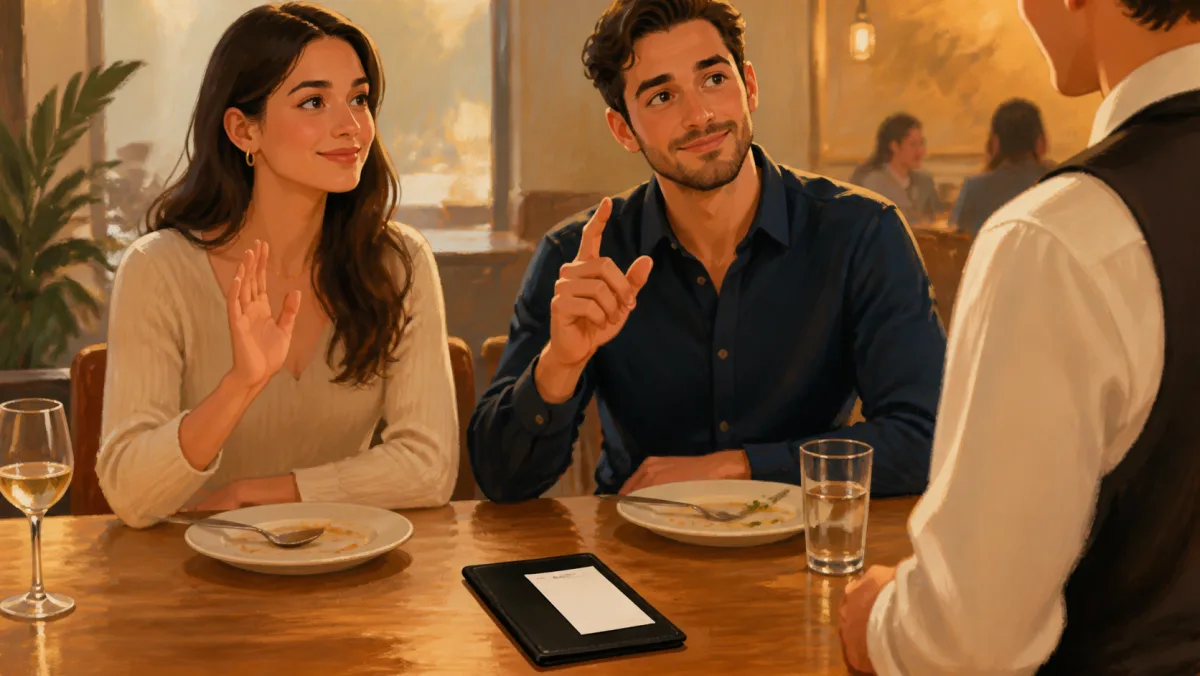
At a U.S. restaurant, the check is the printed or electronic statement of what your table owes. The bill means the same thing, and staff will understand both words, but check is more common in the United States.
“Could we get the check, please?”
This is a standard, polite request; here, check does not mean to inspect something or refer to a bank check.
Why can check mean several things?
In American English, check has several distinct meanings. It can mean an inspection—“a security check”—or a written order to a bank to pay money. It can also mean the restaurant account, and the situation usually makes the intended meaning clear.
“Can you check the check?”
This sentence sounds repetitive, but it makes sense: the first check means review, while the second means the restaurant account.
Cambridge Dictionary notes this regional pattern. British English often uses bill for the restaurant paper, while American English often uses check. This is a common choice, not a firm rule. Americans also use bill in phrases such as pick up the bill and split the bill.
What might you hear in a U.S. restaurant?
A server may ask:
“Would you like the check?”
“One check or separate checks?”
“I’ll bring your check right over.”
One check or separate checks? asks how the table wants to pay. One check puts the full amount together, while separate checks divide it across two or more bills. You can answer:
“One check is fine.”
“Could we do separate checks, please?”
Some restaurant payment systems or policies limit how staff can divide a check, so large groups should ask early.
You may also hear tab, mainly at a bar. With an open tab, you order now and pay later; close out your tab means pay what you owe.
A lot to take in? It is.
But Rome wasn't built in a day. Build your American workplace English one expression and cultural reference at a time—with curated explanations and structured practice in Lyra Practice.
Start a session →What should you say when you are ready to pay?
Natural requests include:
“Could we have the check, please?”
“We’re ready for the check whenever you have a moment.”
“Could I close out my tab?”
“Could you split this between these two cards?”
The last request asks to use two cards, but it does not always request two itemized checks. If each diner needs separate documentation of their items, say so.
At many full-service U.S. restaurants, the server brings the check to your table and may take your card away briefly for processing. Other businesses use a handheld terminal or a QR code, so payment procedures vary.
How does this appear in workplace meals?
At a team lunch, you might hear:
“The company is picking up the check.”
This means the company plans to pay; pick up the bill, cover lunch, and this is on us express the same basic idea.
If expense rules matter, ask before you order:
“Is this a team expense, or should we ask for separate checks?”
“Could I get an itemized receipt for expenses?”
The check shows what you owe, while a receipt shows that you paid. The same paper or screen may serve both roles at different times. Still, a work expense system may require a final itemized receipt.
When a client or senior coworker says “I’ve got this,” they often mean they plan to pay. You can offer once—“Are you sure?”—then accept if they confirm. Payment policies, hosting customs, and expense rules vary, so do not assume one custom applies everywhere.
How can you clarify without sounding awkward?
If someone says “Let’s split the bill,” you can ask:
“Do you mean equal shares or each person’s items?”
Split the bill can mean either choice. Split it evenly means equal shares, while pay for what we ordered means each person pays for their own items.
If a server asks “Together or separate?”, they are asking how to group the payments:
“Together, please.”
“Separate, please—I’m paying for these two seats.”
These short answers are common and polite.
Common misunderstandings
Do not ask for an invoice at a normal restaurant meal unless the business issues one; in U.S. business English, an invoice is usually a formal payment request from a seller.
Also, do not confuse a check with a tip. The subtotal, tax, service fee, and suggested tip may appear on separate lines, so read the check to see what it includes. Laws and restaurant rules vary.
If the amount seems wrong, say:
“Excuse me, I think this item may be on the wrong check.”
This is clear and less direct than “The check is wrong.” It points to a possible error without blaming the server.
For another U.S. dining distinction, see takeout, takeaway, and to go. For casual professional conversation around meals, see how to make small talk at work.