
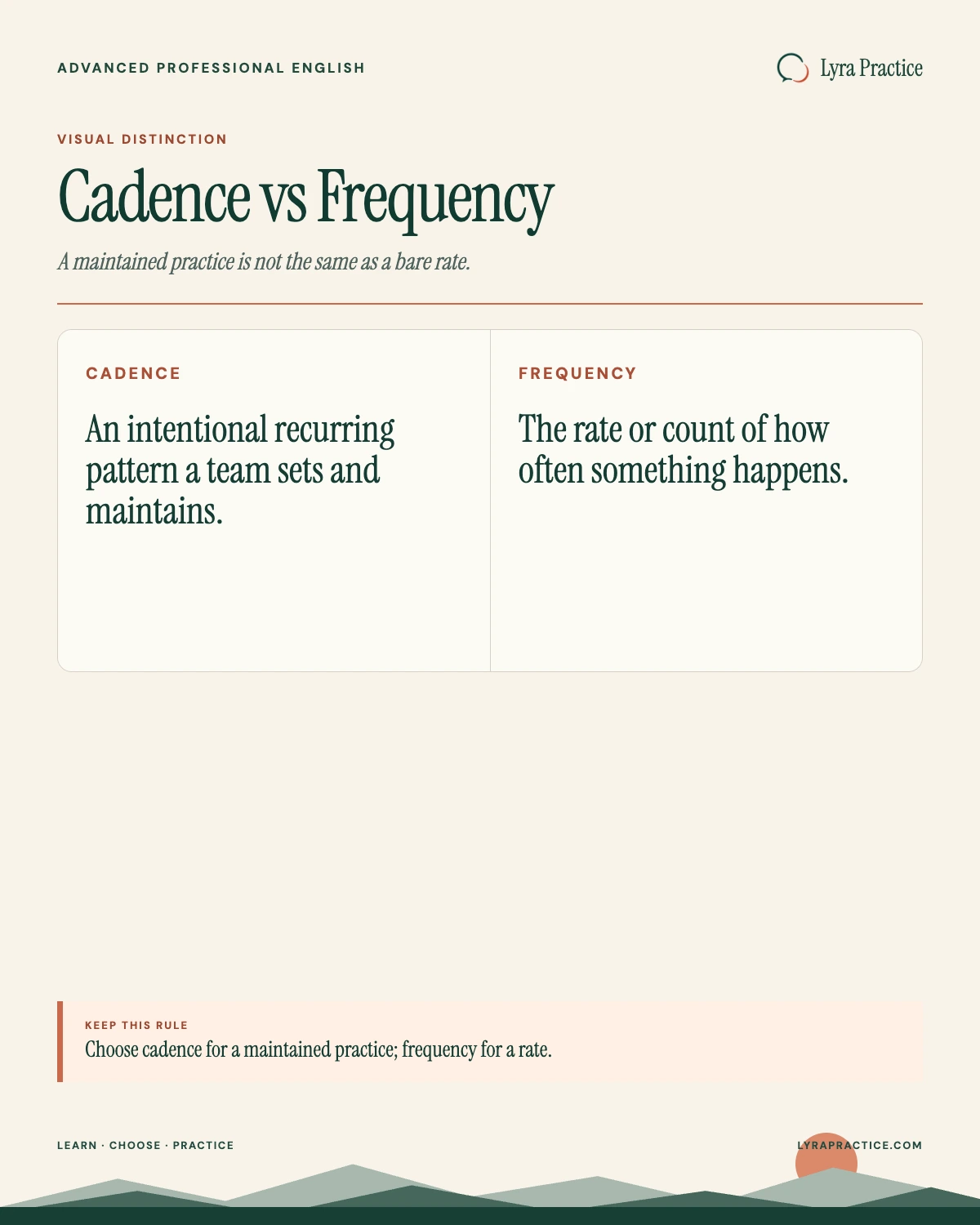
Cadence and frequency are easy to mix up at work, but the distinction is useful.
Use "cadence" for a pattern a team keeps up. Use "frequency" for the numerical rate, or how often something happens. It does not suggest that anyone manages the pattern.
Quick check
Managed practice or numerical rate?
You know "Cadence" well.
Keep going with the full learning path — more workplace contexts, related expressions, and practice using it yourself with feedback.
Continue with "Cadence" →There's more to "Cadence" than it seems.
You've got part of it, but the full learning path goes deeper into its nuances, workplace contexts, and when it sounds natural — then gives you practice using it yourself.
Learn "Cadence" in depth →A rate doesn't say who owns it
Something can happen often without being a planned practice. Its rate does not show who set it up or keeps it going. Frequency gives that rate, while cadence often suggests a steady, managed pattern.
Frequency (bare rate): "Support ticket frequency spiked after the release."
Nobody planned this spike, and the sentence only reports a numerical rate. "Cadence" would be misleading because no one maintains the spike as a practice.
Cadence (maintained practice): "We kept our release cadence steady through the spike so customers knew what to expect."
Here, the team is keeping a practice steady, which is the useful sense of "cadence" at work.
Try it yourself
Write the deliberate release pattern
Save "cadence" for a practice someone runs
Use "cadence" for something a team sets up and maintains. The team can also choose to change it, so responsibility matters. This is a common mix-up, so learn this point first.
Wrong: "Our team has a good cadence of bugs" -- bugs aren't a practice a team maintains; "bug frequency" is the correct word here.
This example makes the mix-up clear. Nobody wants a "good" cadence of bugs because "cadence" suggests a pattern worth keeping. A team wants fewer bugs, not a steady stream.
A quick test
Before using "cadence," ask whether someone runs this as a regular practice. If yes, "cadence" may fit. If you only report a count or rate, use "frequency." It is simpler, but it is not a weaker choice.
Why this mix-up happens so often
Learners often choose frequency because "how often" is a basic idea. That makes the difference easy to miss. A sentence with "frequency" is not grammatically wrong; it simply leaves out the managed pattern. This issue is harder to spot than a grammar error because the sentence still looks fine.
Side by side
"Meeting frequency increased this quarter" only states a fact. "We increased our meeting cadence this quarter" points to a team choice that may need an explanation. Both sentences are correct English, but only the second presents a managed pattern. Choose based on what you want to say about intent.
Practice scenarios
Practice using cadence in situations like these.
- deciding whether a sentence needs the plain rate (frequency) or the managed practice (cadence)
- catching "cadence" used for something nobody is running on purpose, like errors or complaints
- describing a team holding a release or reporting practice steady on purpose
Useful practice phrases to try.
- "Support ticket frequency spiked after the release."
- "We kept our release cadence steady through the spike."
- "That's bug frequency, not a cadence -- nobody's maintaining that on purpose."
Want to actually use "Cadence" naturally at work?
Understanding it is one thing. Practice its nuances, see how it works in real workplace situations, and use it yourself with feedback.
Start the "Cadence" learning path →Frequency measures a rate. Cadence often suggests a maintained practice.
This is a common mix-up, so it is worth learning first.