
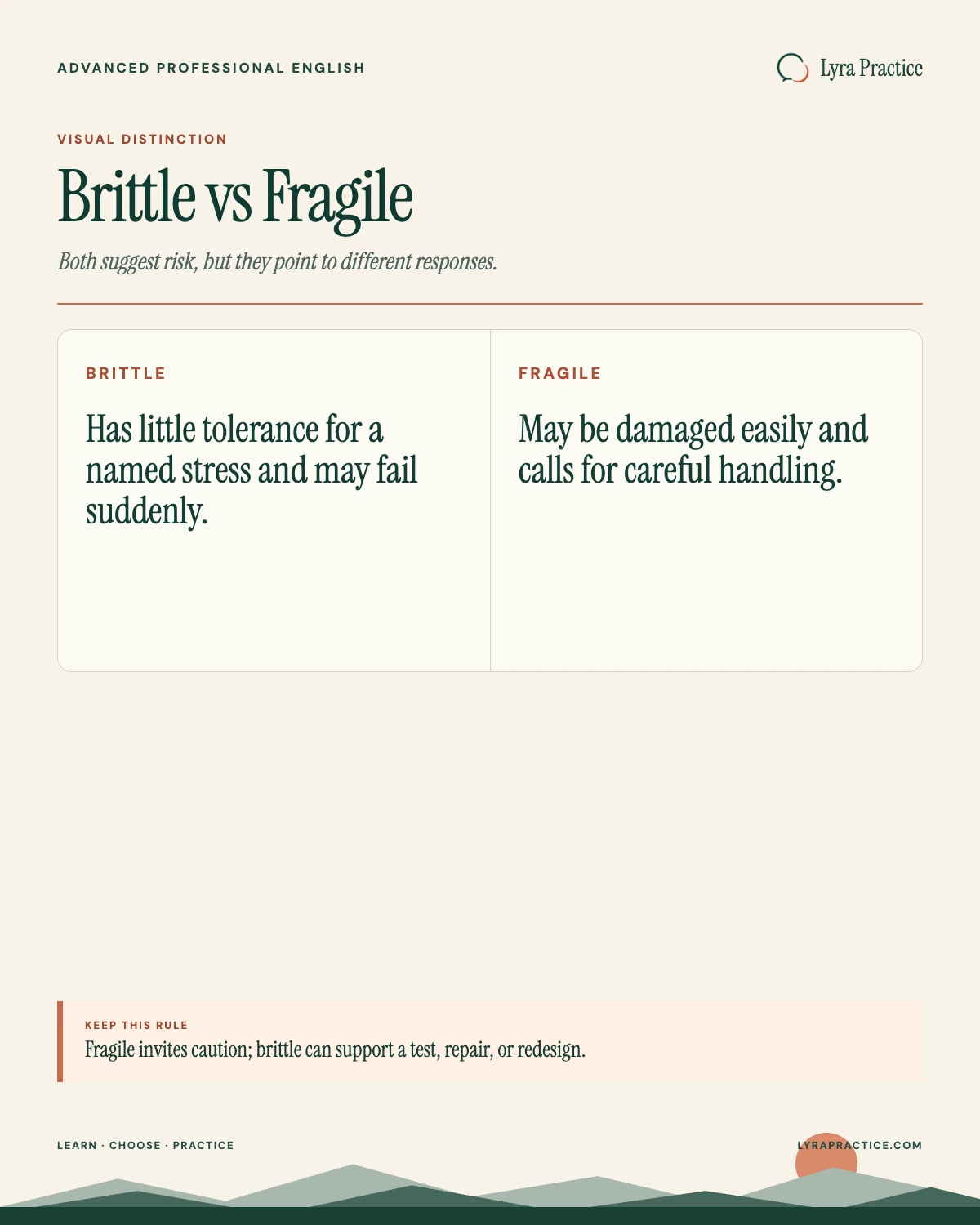
Brittle and fragile can both describe something that may break. However, they focus on different risks. "Fragile" often calls for careful handling. "Brittle" suggests little ability to bend or adapt before a sudden break. At work, that contrast can guide the next step.
Quick check
Caution or redesign?
You know "Brittle" well.
Keep going with the full learning path — more workplace contexts, related expressions, and practice using it yourself with feedback.
Continue with "Brittle" →There's more to "Brittle" than it seems.
You've got part of it, but the full learning path goes deeper into its nuances, workplace contexts, and when it sounds natural — then gives you practice using it yourself.
Learn "Brittle" in depth →The test: caution, or a fix?
Ask what the evidence supports. Is the best response "be careful with this," or "we need to fix this before the load arrives"? "Fragile" points to care. "Brittle" points to poor tolerance for a named stress. In software and operations, it often supports a repair, test, or redesign. The word alone does not decide the action; the owner and evidence do.
A workaround handles today's traffic but fails during peak-load tests: "It's brittle -- current tests show errors above this load" gives evidence; "It's fragile, so please be careful" gives only a general caution.
Calling a component "fragile" asks people to handle it with care; calling it "brittle" can support a redesign when tests show that a named load causes a sudden failure.
The common mistake: defaulting to "fragile" out of politeness
The common mistake is choosing "fragile" only because it sounds softer. If a known condition can cause sudden failure, that word may hide the key risk. "Fragile" asks for care. "Brittle" can call for a fix. Still, avoid certainty unless the evidence is strong. Say whether the concern comes from tests, past incidents, or an estimate.
If you can name a stressor and show how the system reacts, "brittle" may be the better word. Then name the owner, evidence, and proposed response. The response could be a redesign, a test, a limit, or a backup. Focus on "system behavior," not personal blame. For people, trust, or morale, use care: the word can sound harsh and may turn a concern into a personal label.
Try it yourself
Turn Atlas's load test into a repair case
Practice scenarios
Practice using brittle in situations like:
- deciding whether a risky component needs a caution note ("fragile") or a redesign conversation ("brittle")
- catching a message that softens "brittle" down to "fragile" out of politeness
- explaining to a stakeholder why "brittle" is the more actionable of the two words
Useful practice phrases:
- "Tests suggest it's brittle -- it works today but may fail once..."
- "That's fragile, so handle it carefully" vs. "tests show that's brittle, so let's address it before..."
- "Calling it fragile invites caution; calling it brittle may support a fix."
Want to actually use "Brittle" naturally at work?
Understanding it is one thing. Practice its nuances, see how it works in real workplace situations, and use it yourself with feedback.
Start the "Brittle" learning path →"Fragile" often asks for care. "Brittle" often supports a fix.
Choose from evidence, then state the risk and next step in plain language.